

We will now discuss the relationship between personality and the soul. However, since we have yet to study the soul, we cannot fully investigate this relationship in this series. We will mainly examine the question from the perspective of the personality, and the examination of the soul will be the focus of our next series on the Causal Envelope.
The personality consists of the temporary vehicles through which the true person, the Thinker, expresses themself in the physical, emotional, and lower mental worlds. This includes the physical, emotional, and lower mental bodies and all the activities associated with these vehicles.
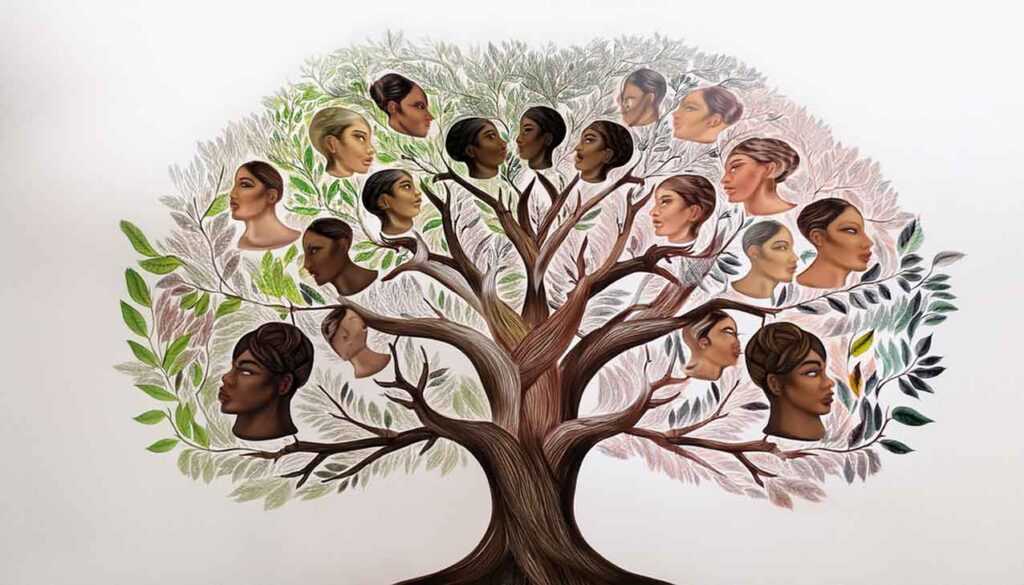
The individuality consists of the thinker— the self in the causal envelope. Just as a tree puts out leaves to last through spring, summer, and autumn, the individuality puts out personalities to last through the life periods spent on the physical, emotional, and lower mental planes. Similar to how leaves take in, assimilate, and pass on nutrients to the sap, which is eventually withdrawn into the parent trunk and then falls and perishes, the personality gathers experience. It passes it on to the parent individuality. Eventually, when its task is completed, the personality falls and perishes.
The soul incarnates into a personality to attain clarity. The soul is magnificent on its own plane but vague in its magnificence on the 1st triad, except for highly evolved individuals.
H.P. Blavatsky’s classification includes four divisions of the mind:
1. Manas-taiji, which Blavatsky identifies as the illuminated manas (47) or buddhi (46), represents the state when manas merges into buddhi and loses its separate will. (This does not quite occur. We are individual monads, and we remain as such for eternity. We expand our consciousness and collectively express a higher will but do not surrender our individuality.)
2. Manas (47) proper, referring to the higher manas (47:1-3) or the abstract thinking mind.
3. Antahkarana is the link or bridge between higher manas and kama-manas during incarnation.
4. Kama-Manas represents the personality according to this theory.
Sometimes, she refers to manas as the deva-soul or the divine aspect distinct from the personal self. Notice the use of the word “deva”. She is alluding to the presence of the augoeides and the significant role it plays in our evolution. The Higher Manas is considered divine because it embodies positive thought, which is known as kriyashakti, the power to manifest action, as all work is essentially carried out by the power of thought. The word “divine” is derived from “div,” meaning “to shine,” and it signifies the inherent divine quality of life that emanates from within manas.
The lower mind (47:4-7) is only a reflector, with no light of its own; it is simply a vessel through which the light and sound pass – just a persona, a mask.
In the Vedanta tradition, particularly in Shri Shankaracharya’s school, the term “antahkarana” refers to the mind in its broadest sense. It encompasses the entire internal organ or instrument that functions between the innermost Self and the external world. This concept is consistently described as having four components.
[1] Ahamkara————The “I maker.”
[2] Buddhi —————-Insight, intuition, or pure reason
[3] Manas —————-Thought
[4] Chitta —————–Discrimination of objects
What the Western individual typically refers to as their mind, with its abilities of concrete and abstract thinking, corresponds to the last two in the aforementioned classification: Manas and Chitta.
The Theosophist should recognise in the Vedantic divisions their own familiar atma (45), buddhi (46), manas (47:1-3), and the lower mind (47:4-7).
In the symbolism of Freemasonry, the lower mind and the mental envelope are represented by the S.D. (senior deacon).
The following table sets out the principles of individuals in the system of Freemasonry.
Thus, the Higher Triad or Spiritual Trinity, both in God and Humanity, is represented in Freemasonry by the three Principal Officers. In contrast, the lower self, personality, or quaternary, is represented by the three Assistant Officers and the Tyler (guard).
In Christianity, we find the following symbolism:-
The process of a soul taking on a personality has been compared to a spark projecting from the Flame of Mind. Just as a flame ignites the material it lands on and gives rise to a new flame with the same essence but separate for the purpose of manifestation, it is said that a single flame can light a thousand candles without being diminished, resulting in a thousand visible flames where only one was visible before.
The individual who thinks for themself endures eternally. They are like the timeless youth mentioned in the Bhagavad Gita, who changes bodies as easily as a person changes clothes. Each personality is a new role for the immortal Actor, and it plays out the drama of human life repeatedly. Each character it takes on is connected to the ones before and after, creating a continuous life story.
The different aspects of a person’s personality are connected through the memories created by the impressions on the three lower vehicles. Additionally, the individual’s identification with their vehicles establishes their personal consciousness, known as Ahamkara, which comes from Aham (meaning “I”) and kara (meaning “making”). Together, Ahamkara means the “I-maker.”
In the early stages of evolution, the “I” consciousness resides in the physical and emotional bodies, with the most activity occurring in these vehicles. Later, it transitions to the lower mental sheath, becoming predominant here.
The personality, with its fleeting feelings, desires, passions, and thoughts, forms a quasi-independent entity. Yet, it constantly draws its energy from the Thinker it envelops. Furthermore, the qualifications of the lower worlds often conflict with the long-term interests of the individual, leading to a struggle within the self. Sometimes, temporary pleasure wins, and sometimes, lasting gain prevails.
In dealing with the personality, the obstacle to be overcome is asmita, the notion that “I am this”, or what a Master once called “self-personality”. Throughout life, the personality develops into a distinct entity with defined physical, emotional, and mental characteristics, as well as specific occupations and habits. There is no issue with this as long as it is a positive example. However, if the inner self starts to believe that it is the personality, it will start serving the interests of the personality instead of using it as a tool for spiritual growth. As a result of this misconception, individuals seek excessive wealth, power, fame, and so on. “Self-personality” presents the greatest obstacle to utilising one’s personality for spiritual progress.
The life of an individual begins when the Thinker forms a new mental envelope, as discussed in a previous presentation, and lasts until that mental envelope disintegrates at the end of the period spent in devachan.
The soul’s objective is to uncover its hidden abilities, which it achieves by experiencing different personalities. Many people, who currently make up the majority of humanity, don’t grasp this concept. They mistakenly consider their personality as their true self and live solely for its temporary benefits, regulating their lives accordingly.
The person who truly understands realises that the only important thing is the life of the soul and that its progress is the objective for which the temporary personality must be used. Therefore, when they have to decide between two possible courses of action, they do not, like most people, consider which will bring them greater pleasure or profit as a personality but which will bring greater progress to them as a soul. Experience soon teaches them that nothing bad for all can ever be good for them or anyone. Through this, they learn to forget themselves entirely and to consider only what is best for humanity.
The student needs to be cautious of intensifying their personality at the cost of their soul. Let’s look at the common failing of selfishness as an example. Selfishness is primarily a mental attitude or condition, so its impact will be seen in the mental realm. Since it enhances the personality at the expense of individuality (the monad), it will magnify the negative aspects of the personality, causing selfishness to become more pronounced and stronger over time. This is part of the karmic law and underscores how detrimental persistence in selfishness can be to progress. Nature’s harshest punishment is the denial of opportunities for progress, whereas its greatest reward is the presentation of such opportunities.
When a person rises to a level somewhat higher than an ordinary individual, and their primary activity becomes mental, there is a danger that they might identify themselves too closely with the mind. Therefore, they should strive to identify themselves with the soul, the monad focused in the 47:1 permanent atom, and make the soul the focal point of their consciousness, thus merging the personality into the individuality.
The student should strive to understand that the mind is not the knower but rather the instrument that the Knower uses to acquire knowledge. Identifying the mind with the Knower is like identifying the chisel with the sculptor who uses it. The mind constrains the Knower, who, as self-consciousness develops, feels restricted by it in every aspect. Just as wearing thick gloves diminishes one’s sense of touch, the same happens to the Knower when they associate with the mind. The hand is inside the glove, but its capabilities are significantly reduced; similarly, the Knower is present within the mind, but their powers are limited in their expression.
This fascinating topic gets to the heart of who we think we are and who we actually are. See you in the next presentation.