
Today, we take up the story of the attachment of the monadic atom to the higher triad of atma-buddhi-manas. We will start off by looking at how the devas activate the less conscious monads that make up the fabric of our solar system. In the First Elemental Kingdom, on the higher mental or causal plane (47:1-3), the devas make materials ready to clothe abstract thoughts. In the Second Elemental Kingdom, on the lower mental plane (47:4-7), they make materials ready to clothe concrete thoughts. In the Third Elemental Kingdom, on the emotional plane (48), they prepare materials for the clothing of desires. It is incredible to think that for us to have an emotion of any sort, a parallel stream of evolution had to work with lower levels of conscious monads to prepare the groundwork for me to have an emotional response to a bar of chocolate.
At the stage we are now considering, this work of improving the Elemental Essence is the only work they can do. Later on, they are also constantly busy with the shaping of forms, aiding human souls on the way to incarnation, building their new bodies, bringing materials of the kind required, and helping in its arrangements—the less advanced the soul, the greater the directive work of the Devas. They do almost all the work with animals and practically all with vegetables and minerals. They are the active agents of the Logos, carrying out all details of His world plan and aiding the countless evolving lives to find materials they need for their clothing and use. Included with them are the vast numbers of fairy kingdoms, known as nature spirits, trolls, and gnomes, these entities being known by countless other names.
The Emotional and Mental Body presentations contain some descriptions of these different beings, so there’s no need to describe them further here. We’re interested in where they come from and how they help the Monads start their evolution in the lower planes.
The term “Deva” doesn’t cover all the living agencies involved in the work related to the Monads and their long journey through the lower worlds. There are seven orders of beings, known collectively as Creative Hierarchies, and the human Monads are one of the seven. Don’t forget that all the other entities, down to the humblest primary atom, are also monads. Still, we will elevate ourselves to a favoured “monad” status for these presentations.
It is worth clarifying what we mean by the Creative Hierarchies. In esoteric writings, the concept of “Creative Hierarchies” refers to a structured system of spiritual entities or energies that play a role in the cosmic order and the evolution of consciousness. According to Alice Bailey and other esoteric authors, these hierarchies are divided into twelve great orders, with seven of them being actively involved in planetary expression in our solar system.
There are twelve creative hierarchies, divided into seven actively involved in planetary expression and five considered pure abstractions. These hierarchies are part of a larger cosmic framework and are associated with different levels of consciousness and spiritual development. Within the greater cycle, three hierarchies are particularly significant: the fourth or human Creative Hierarchy, and two deva (angelic) hierarchies, the fifth and the sixth. The human hierarchy is often referred to as the Hierarchy of Initiates, highlighting its role in spiritual evolution.
The Creative Hierarchies are also linked to astrological systems, with influences coming from constellations such as the Great Bear, the Pleiades, and Sirius. These connections suggest that the hierarchies are channels for cosmic energies that affect the solar system and the planets. The hierarchies are seen as intermediaries that transmit higher energies to the solar system and Earth, facilitating spiritual growth and the integration of spirit and matter, or, to put it another way, the evolution of the monad through the expansion of its consciousness.
For simplicity, we’ll refer to all the agencies that assist us in our evolution as “Devas” for now. Still, in a later presentation, we’ll revisit this and provide more details, including the names and functions of the seven Creative Hierarchies.
Before any embodied consciousness, besides that of the Logos and His Creative Hierarchies, could emerge or do anything, substantial preliminary work had to be done to prepare the “form side” of the evolutionary field. On the form side, we refer to the material structure of the solar system.
We now have the three factors needed to consider the attachment of atoms to the Monads. These three factors are:
1. The atoms of the various planes.
2. The Monads’ readiness on the adi (43) plane.
3. The assistance of the Devas. Without them, the Monads would be powerless to carry out their evolution.
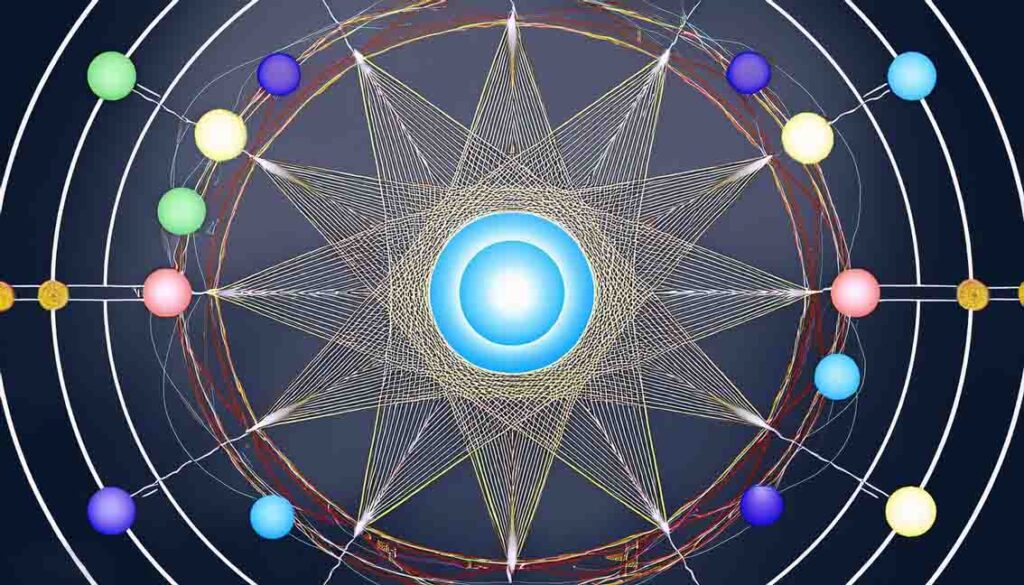
The Monad has three aspects of consciousness. When the time comes for the evolutionary process to begin, each aspect sets up a vibratory wave, causing the atomic matter of the planes of Atma (45), Buddhi (46), and Manas (47), which surround the Monad to vibrate.
Devas from a previous round of the Solar Logos’ own evolution, who have themselves undergone a similar experience, guide the vibratory wave from the Will-aspect of the Monad to an atom of Atma. This atom becomes “attached” to the Monad and is called its Atmic permanent atom, as it remains with the Monad throughout the entire evolutionary process in the solar system. Similarly, the vibratory wave from the Wisdom aspect of the Monad is guided by Devas to an atom of Buddhi matter (46), forming the Buddhic permanent atom. Likewise, the vibratory wave from the activity aspect of the Monad is guided by Devas and attached to an atom of Manas (47), creating the third permanent atom. This formation is known as Atma-Buddhi-Manas. This is why I use this terminology, although I use Bladon’s naming system in most diagrams. This complex of three permanent atoms is often referred to as the Ray of the Monad.
The process is described as follows in the Book of Dzyan: “A tiny thread of light separates from the luminous ocean of Atma, and a spark hangs from this thread. The spark is then enclosed in an egg-like casing of matter from the formless levels of the mental plane. This spark hangs from the flame by the finest thread of Fohat”. The Book of Dzyan is a reputedly ancient text that forms the basis for “The Secret Doctrine,” a foundational work of the theosophical movement by H.P. Blavatsky. Blavatsky claimed that the Book of Dzyan is part of the secret volumes of the Kiu-te and that she encountered it while studying esoteric lore in Tibet. According to her, the book was written in the sacred language of Senzar, which is unknown to philology. It would be, as it is supposed to be, the language the Atlantians used.
Here we have the mystery of the Watcher, the Spectator, and the actionless Atma, i.e., the Monad. The Monad abides ever in his highest nature on his own plane and lives in the world by his Ray [AtmaBuddhiManas], which in turn animates his “shadows”—the lives or incarnations of the lower self on earth.
Atoms that are attached to Monads are called “permanent atoms” or “life atoms” according to H.P. Blavatsky. The remaining atoms of the various planes, not attached to Monads, are referred to as the Monadic Essence of each plane. This essence can be suitable for attachment to monads as permanent atoms, although not all become attached.
Atma-Buddhi-Manas, also known, as already mentioned, as the Ray of the Monad, goes by many names, such as the Heavenly Man, the Spiritual or Higher Triad, the Higher Self, the separated Self, and so on. Sometimes, it is also referred to as Jivatma, meaning Life-Self, which equally applies to the Monad. It is known as the “manhood” of the Divine Son of the First Logos, animated by the Monad and as a vessel into which the Monad pours Its life.
Theosophy regards the Monad as the fundamental aspect of consciousness. They fail to highlight that it is also the fundamental and self-energised aspect of matter. The Monad resides on its own plane and interacts with the world through its lower aspects, known as the Atma-Buddhi-Manas or the Higher Triad. I would call it the middle triad, but the Theosophists regard the 3rd Triad as formless and place it outside our passage through the Cosmic Physical Plane. This interaction occurs despite the Monad’s inherent nature being unaffected by the material world. The material world is the whole of the Cosmic Physical Kingdom (43-49).
It’s important to note that the Higher Triad is essentially the same as the Monad, albeit with reduced power due to the influence of material existence. Although human consciousness exhibits various manifestations, it is ultimately a singular entity.
Having taken possession of the three atoms, the Monad has started its work. It cannot descend below the higher monadic plane (43:1-3) in its own nature; therefore, it is described as being in “Silence and Darkness,” meaning unmanifest. However, it lives and works through the atoms it has taken and focuses itself through.
The Monad begins its work by utilising the three atoms that constitute the Higher Triad. While the Monad is strong and conscious on its own plane, it is relatively powerless and unconscious on the lower planes. In this, the monad is watched over and aided by the all-sustaining and life-preserving actions of the Second Logos until, eventually, it can live in the lower worlds as fully as it lives above. It can then become, in its turn, a creative Logos and bring forth a universe out of itself. Fancy that! A Logos does not create out of nothing; instead, he evolves all from himself. Don’t be fooled into thinking that the monad is somehow omnipotent where it resides. It may have innate power, but it is unconscious until it evolves through the kingdoms of nature, leading back to Plane 43.
The full manifestation of the three aspects of consciousness expressed by the Monad mirrors the emergence of the Triple Logos in the universe. The aspects of Activity, Wisdom, and Will are revealed in a specific order, culminating in the revelation of the Divine Power of the Self, Atma.
I hope you have been suitably illuminated. In the following presentation, we will examine the attachment of atoms to the lower triad.