

In this presentation, we seek to conclude our look at the individualisation of a monad. “Man” has been well defined in Occultism as the being in the universe, wherever he may be, in whom the highest Spirit and lowest Matter are joined together by intelligence. Ultimately, this creates a manifested God who will go forth to conquer through the boundless future that stretches before him. Man himself, the reincarnating soul, should preferably be considered as the Thinker rather than as Mind, for the word Thinker suggests an individual Entity, whereas the word Mind suggests a vague, diffused generality.
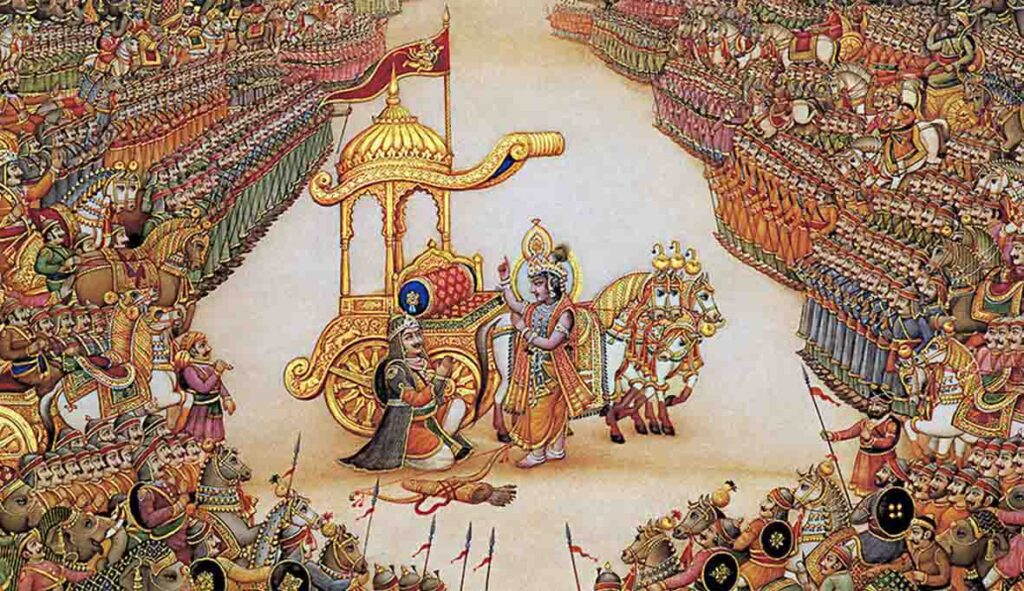
In broad terms, the phases of involution and evolution consist of seven stages. In the first three stages, the Spirit descends and broods over Matter, imparting qualities, powers, and attributes to it. The fourth stage is unique, as it is when Matter, now imbued with various powers and attributes, comes into manifold relations with the informing Spirit, which now enters it. This stage represents the great battle of the universe, the conflict between Spirit and Matter, akin to the battle of Kurukshetra with vast opposing armies. For those of you who may not know, Kurukshetra is the land where the epic battle of the Mahabharata took place, an allegory if there ever was one. At this point, the Spirit, entering into numerous relations with Matter, is initially overpowered. Then, a point of balance is reached where neither has the advantage over the other. Gradually, the Spirit begins to triumph over Matter so that by the end of the fourth stage, the Spirit becomes the master of Matter and is prepared for its ascent through the final three stages that complete the seven.
In these stages, the Spirit organises the Matter that it has mastered and ensouled. It turns the Matter to its own purposes and shapes it for its own expression, so that the Matter may become the means whereby all the powers of the Spirit shall be made manifest and active. The last three stages are taken up by the spiritual ascent.
The 7 Stages of Involution and Evolution can be defined in the following manner:
In Stages I, II, and III, Spirit descends and imparts qualities to Matter, as indicated by the arrows branching out laterally.
During Stage IV, Spirit and Matter are in conflict, as shown by the two opposing arrows and the cross-lines symbolising the battleground of life.
In Stages V, VI, and VII, Spirit ascends, gradually attaining mastery over Matter.
The diagram attempts to illustrate the division of the line of Spirit, with multiplicity emerging from unity and the return of Spirit to its source level, enriched by its experiences with and mastery over matter.
The principle illustrated here is a recurring one in nature and can be seen in various processes, such as the cycle of human reincarnation. It is important for the student to understand this principle clearly, as it will aid in comprehending other aspects of the ‘Ancient Wisdom’.
The entire process of moving downward into matter is referred to in India as the pravritti marga, or the outgoing path. After reaching the necessary lowest point, a person embarks on the nivritti marga or the path of return. This represents the return from the day’s work of harvesting, carrying the awakened consciousness, which allows the person to be more useful than before their descent into matter.
In the course of humanity’s development, intellectual evolution may temporarily overshadow spiritual evolution. The spiritual aspect must make space for the rapid advancement of intelligence and take a back seat for a while, allowing intelligence to take the lead and navigate the next stages of evolution.
Gradually, the Monad will silently and subtly start to influence the intelligence. It will work indirectly, stimulating the intelligence with its energies and continuously evolving it from within. At the same time, the intelligence will struggle to control the lower vehicles, initially conquering and subduing them but eventually mastering and governing them. The spirit is initially obscured and matures in silence while the warrior intellect continues to struggle. Eventually, intellect will surrender its achievements to the spirit. As a result, humanity will become divine and reign as the master, no longer a slave, on the lower planes, symbolically referred to as ‘earth’.
The intellect is essentially the separative principle in Humanity, which distinguishes the “I” from the “not I”. It is conscious of itself and perceives everything else as outside itself and different. The intellect is the combative, struggling, self-assertive principle, and from the level of the intellect downward, the world seems to be a scene of conflict, especially when the intellect is involved. Even a passionate nature becomes combative only when stirred by desire and encounters obstacles to achieving its desires. As the mind inspires its activity, the passionate nature becomes more aggressive, seeking to fulfil future desires and taking more from nature’s resources. The intellect seems inherently combative, as its very nature is to assert itself as distinct from others. Therefore, we can trace the source of separateness and divisions among people back to the intellect. Unity becomes apparent when the Unity plane (46) is reached, which will be discussed in a later presentation.
The student should not think of a human only as a being that functions through the mind or intellect. In reality, humanity is a Spark of the Divine Fire known as the Monad. The Monad expresses itself in three aspects: as Spirit in the world of Atma (45), as Intuition in the world of Buddhi (46), and as Intelligence in the world of Manas (47). Together, these three aspects form the soul that resides in the causal envelope, which was created from a fragment of the Group Soul. Thus, while a human is a Monad residing in the monadic world, the same human appears as a soul in the higher mental world, displaying the three aspects of Spirit, Intuition, and Intelligence.
The soul represents the human stage of evolution and is the closest correspondence to our traditional concept of the soul. It remains unchanged, except for its growth, from the moment of individualisation until humanity transcends and merges into divinity. The soul is not affected by what we consider as birth and death, as these are only a part of its real existence. The lower bodies, which are born and die, are simply temporary coverings that the soul uses for a certain phase of its evolution. A succinct way to express this is that a person is an eternal individual, possessing a temporary personality.
In the entire span of human existence, there are three distinct changes that surpass all others in importance and significance.
(1) The first of these stages is when an individual enters the human kingdom, emerging from the animal kingdom and beginning their journey as a soul.
(2) The second stage is the completion of the first of the great initiations.
(3) The third stage is the attainment of Adeptship (45-Self).
Here, we are only concerned with (1) – achieving individualisation. Stages (2) and (3) will be addressed later.
To achieve individuality is the goal of animal evolution, and its development serves a specific purpose: to establish a strong individual centre through which the force of the Logos can ultimately be expressed.
When such a centre is first formed, it is, of course, merely a baby soul—weak and uncertain. In order for it to become strong and definite, it has to be fenced around by selfishness, the intense selfishness of the 1. Young soul. For many lives, a strong wall of this selfishness has to be maintained so that within it, the centre may grow more and more definite. Selfishness can be seen as a necessary temporary support, like scaffolding, when building something. Once the construction is finished, the selfishness needs to be removed so that the final creation can fulfil its purpose. The scaffolding is not aesthetically pleasing, and if left in place, the end result would not be usable. However, without the initial selfishness, the creation would not have been possible at all. So the next time you are accused of being selfish, just tell people you are “evolving”.
The centre-facing focus of the personality was created so that the force of the Logos could radiate out into the world. This radiation would have been impossible if selfishness had persisted. However, without selfishness in the earlier stages, a strong centre could never have been established.
Therefore, based on this comparison, we can understand that even the least attractive qualities have a purpose in the process of evolution, but only at the right time. However, for many people, selfishness no longer serves a purpose, and they should strive to eliminate it completely. It is pointless and irrational to be upset with individuals who are selfish, as their behaviour suggests that a trait which was essential in primitive times still lingers in modern society. A more enlightened approach towards selfish individuals is to view them as out-of-date remnants of ancient times, individuals who have not adapted to the current era.
This diagram summarises the results of the four stages a monad evolves through in the first four kingdoms of nature. It shows the relative positions in the evolutionary scheme of the stages we know as the mineral Group-Soul, the Vegetable Group-Soul, the Animal Group-Soul, the Animal ready to Individualise, and the Human Being in its Causal Envelope.
In the next presentation, we will look at the methods and degrees of individualisation.