
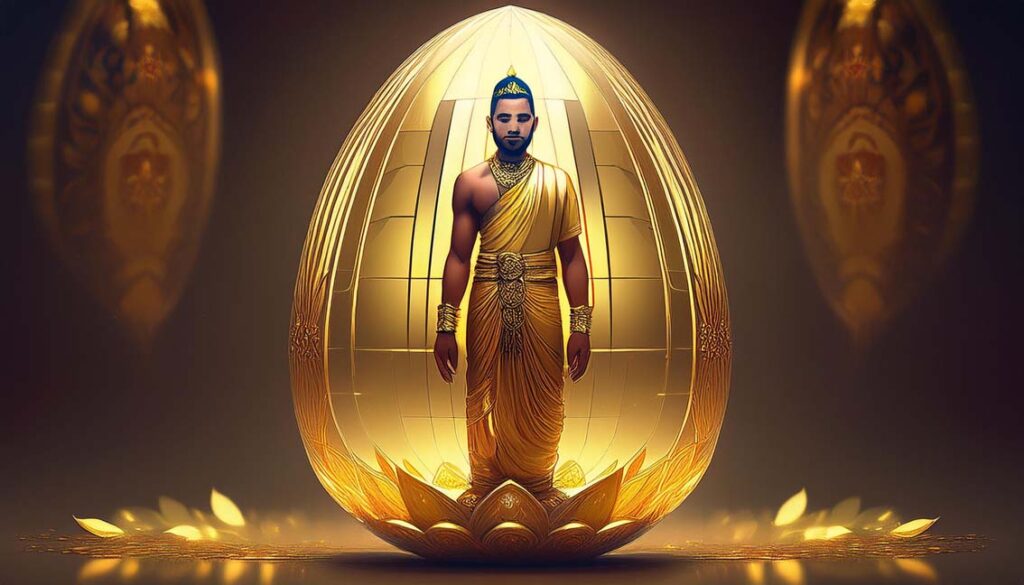

We know the causal envelope (47:1-3) to be part of the mental envelope that somehow seems to exist and function remotely from the rest of the mental envelope. What function does it serve? The causal envelope is named for housing the causes that manifest as effects on the lower planes. Sounds simple enough; let us investigate further. It is the experiences of past lives, stored in the causal envelope, that cause the general attitude towards life and the actions taken by the monad as it evolves its consciousness. The causal envelope in Sanskrit is known as the Karana Sharira, with “Karana” meaning “cause.” In short, we can say that the causal envelope serves two main functions:
(1) The causal envelope acts as a vehicle for the Soul or the “envelope of Manas”, representing the form-aspect of the individual, the true person, the Thinker.
(2) The causal envelope acts as a receptacle or storehouse for the essence of a person’s experiences in their various incarnations. It encompasses everything enduring and stores the germs of qualities to carry over to the next incarnation. Therefore, the lower manifestations of a person – their expression in their mental, emotional, and physical bodies – ultimately depend on the growth and development of the real person, the one “for whom the hour never strikes”.
In a previous presentation, we learned that a person only becomes a true individual when their causal envelope comes into existence. Every individual must have a causal envelope in order to truly be considered an individual.
The immense amount of work done in the long ages before the creation of the physical world is devoted to developing and building the material of the physical, emotional, and lower mental planes until it becomes a suitable dwelling for the divine spirit to inhabit as a human.
The causal envelope, also known as the form aspect of the true person, is described as a delicate film of the subtlest matter, barely visible, marking the beginning of an individual’s separate life. This almost colourless film, which is the envelope that will last throughout human evolution, serves as a thread-self or Sutratma, on which all future incarnations will be strung. The causal envelope is the receptacle of all that is enduring – only that which is noble, harmonious, and in accordance with the law of spirit. Every great and noble thought, every pure and lofty emotion is carried up, and its essence is worked into the substance of the causal envelope. Therefore, the condition of the causal envelope is a true register, the only true register of the growth of a human being and the stage of evolution that this human has attained.
All the different aspects of the human body should be seen as casings or vehicles that allow the Self to operate in specific parts of the solar systemic world. Just as a person might use a car on land, a ship on the sea, or a balloon in the air to travel from one place to another and yet still remain the same person in all places, so does the Self, the true essence of a person, use its various bodies for their intended purposes, while always remaining itself regardless of the vehicle it operates in at any given moment. In relation to the person, all these bodies are temporary; they serve as instruments or helpers, wearing out and being renewed over time and adjusting to the person’s changing needs and increasing capabilities.
In essence, because the mind has a fundamentally dual nature in its functioning, humans require and are equipped with two separate aspects of the mind. As discussed in the series on The Mental Envelope, the mental envelope is associated with the concrete mind, which processes specific thoughts, while the causal envelope serves as the mechanism for abstract thinking.
The Thinker, residing in the causal envelope, embodies all the powers that we associate with the Mind – such as memory, intuition, and will. The Thinker gathers all the experiences from the lives on earth that it has passed through and transmutes them within itself through divine alchemy, creating an essence of experience and knowledge known as Wisdom. Even in a short life on earth, we can differentiate between the knowledge we gain and the wisdom we distil from that knowledge, often too infrequently. Wisdom is the culmination of a lifetime of experiences and is the greatest possession of the elderly. In a much broader sense, Wisdom is the result of many incarnations, the product of extensive experience and knowledge. Thus, the Thinker holds the store of experiences gathered from our past lives, accumulated through numerous rebirths.
In the Hindu classification of the bodies of humanity as “sheaths”, the causal envelope is known as the discriminating sheath. You notice in this classification system, the lower mental and emotional bodies are combined. I have mentioned this once before. Anyway, I have included it here in the following table:—
What does the discriminating sheath do? Its job is to separate and arrange memories. Experiences from the mental and the emotional sheaths or envelopes are reflected as ideal concepts in the causal envelope. The Manomayakosha, as the lower mental/emotional complex is referred to in this classification system, collects and elaborates, while the Vijnanamayakosha or causal envelope arranges and discriminates. The lower bodies receive and deal with sensations and perceptions and the making and elaborating of ideas, but it is the work of the causal envelope to arrange these, discriminate between them, and perform the work of abstract reasoning from them, dealing with pure ideas separated from the concrete presentations.
In the causal envelope, we have the abstract rather than the concrete – pure internal workings untouched by the senses and un-interfered with by the outer world. Here, there is pure intelligence, clear vision, and tranquillity – intelligence unmoved by the senses and tranquil, strong, and serene.
The causal envelope contains the creative power of meditation and the energies that arise from focused contemplation. This is humanity’s creative aspect, as Manas in humanity corresponds to Mahat in the Cosmos, which is the Universal Mind and Divine Ideation. This is the directing force that moulds and creates, giving rise to all forms. All potential forms exist within this aspect of humanity, and they can be given objective reality through this creative power.
The Secret Doctrine states: “Kriyashakti is the mysterious power of thought that enables it to produce external, perceptible, phenomenal results through its own inherent energy. The ancients believed that any idea would manifest itself externally if one’s attention were deeply concentrated upon it. Similarly, intense volition would be followed by the desired results.” This, of course, is the secret of all true “magic”.
The intelligence in a person is considered the reflection of Brahma, or the Universal Mind, which is the creative energy. The creative faculty of imagination in humanity, currently working in subtle matter, will eventually work in grosser matter as well when the human is perfected. The imaginative power in a person is seen as the reflection of the power that created the universe. Just as Brahma meditated and all forms came forth, the creative power of the mind contains the potential for all forms.
H.P. Blavatsky sometimes refers to manas as the Deva-soul or the divine self as opposed to the personal self. Higher Manas is divine because it involves positive thought, which is Kriyashakti, the power of doing things. Manas, or mind, is inherently active. All work is actually done through thought power; the sculptor’s hand doesn’t do the work, but rather it is directed by thought power. It is true to say that thought comes before action. While there are times when a person seems to act without thinking, even then, their action is the result of prior thought. They have developed a habit of thinking along a certain line and acting instinctively in line with that thought pattern.
The higher mind is considered divine because it is a positive thinker that uses its own inner light to shine. This divine quality is associated with the word “divine,” which comes from the root “div”, meaning “to shine.” The outward energy of the Atma (spirit) working in the causal body is the force that shapes everything external to it. In contrast, the outward energy of the Atma working in the “Manomayakosha” (the mental sheath) is desire, which is attracted to external objects and influenced from the outside. However, in the causal body, the Atma manifests as will, which is no longer influenced by external factors, but is guided by inner choices formed through discerning reflection. This essential difference between will and desire demonstrates that will is a quality of the soul, not the personality.
The first aspect of humanity to evolve is the Chit, or intelligence, which is the analysing faculty that perceives multiplicity and differences. Next comes Ananda, the wisdom that realises the unity of things and achieves union, thereby finding the joy or bliss at the heart of life. Lastly, there is the third and highest aspect, Sat, which represents self-existence and unity, which transcends even union.
In the cycle of races, the Fifth Root Race develops the Chit, or Intelligence, aspect. The Sixth will develop the Ananda, the union or bliss aspect, the “Kingdom of Happiness”. The Seventh will develop the Sat, or Self-existence aspect. Now, that is something to look forward to.
We now know the functions of the causal body. In the following presentation, we will examine its composition and structure.
Congratulations on your new AM frontend! I tried most of the buttons, and they functioned as expected. You run a very polished learning center, the goods are delivered with elegance, and the content is mind-blowing.
I found the overlay of HPB’s Indian concepts with Hylozoics as an added touch to increase overall understanding. Bravo Kazim!
BTW – I hope “humanity” does not wait till the 6th root race to get with the program – that’s a lot of incarnation cycles…
The front end is thanks to the hard work of Mihail Craniunescu, a Romanian friend of mine, who happens to be an IT wizard. Sanat Kumara sent him specifically to Earth to help me!!!