
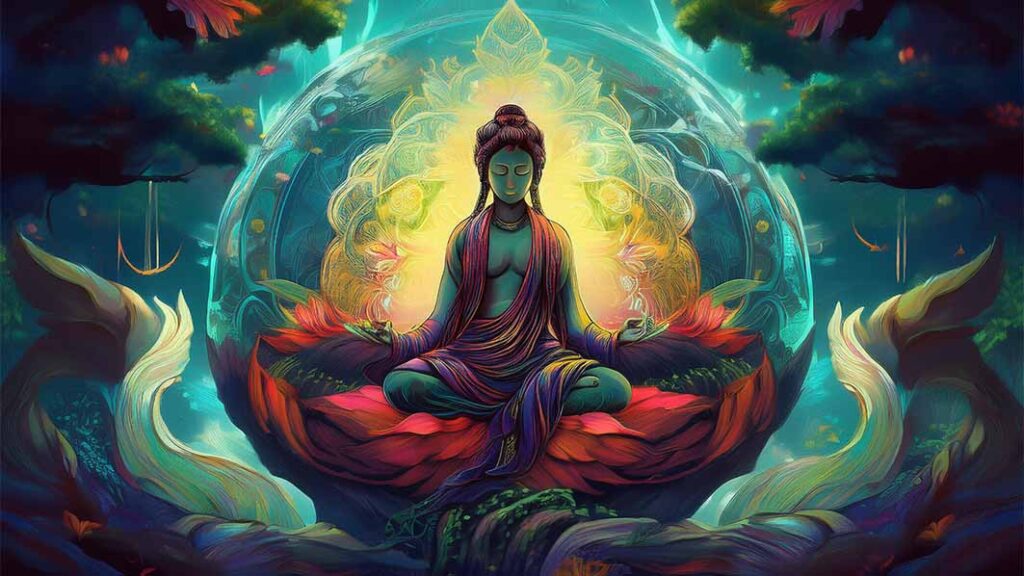

As the soul reincarnates, it has to carry the burden of its past, which has been stored as vibratory tendencies in its permanent atoms. Buddhists refer to these germs or seeds as Skandhas. These Skandhas consist of material qualities, sensations, abstract ideas, tendencies of mind, mental powers, and other qualities. The pure essence of these is built into the causal envelope, while the rest is stored in the permanent atoms and mental unit.
H.P. Blavatsky vividly describes the soul coming to rebirth and being met by its Skandhas. “Karma, with its arm of Skandhas, waits at the threshold of Devachan, from which the soul re-emerges to assume a new incarnation. At this moment, the future destiny of the rested soul trembles in the scales of just retribution as it falls under the sway of active Karmic Law. In this rebirth, selected and prepared by the mysterious, relentless, yet infallible LAW, the sins of the previous life of the soul are punished. The soul is not cast into an imaginary hell with theatrical flames and ridiculous devils but onto this earth, the plane and region of its sins, where it will have to atone for every bad thought and deed. As it has sown, so will it reap. Reincarnation will gather around the soul, all the other souls who have suffered directly or indirectly from the past personality. The new personality is like a fresh suit of clothes with specific characteristics, colour, form, and qualities, but the real person who wears it is the same culprit as of old”. Hence, it is the law of Karma that guides the person unerringly towards the race and nation where the general characteristics found will provide a social environment fitted for the manifestation of the general character built up by the soul in previous earth-lives and for reaping the harvest it has sown. Karma thus follows the path that shapes the Soul’s journey to its next incarnation. This Karma represents the sum of all causes initiated by the Soul itself.
When considering the interplay of karmic forces, it’s important to consider one key factor: the soul’s willingness to accept conditions for its earthly existence that may not align with what the personality would choose for itself. The lessons learned through experience are not always pleasant. From the perspective of the limited knowledge of the personality, much of earthly experience may seem needlessly painful, unjust, and futile. However, before immersing itself in earthly life, the soul sees the causes that lead to the conditions of the upcoming incarnation, as well as the opportunities for growth that will be provided. It’s easy to understand, then, how the passing sorrows and pains of life will be weighed lightly in comparison to the piercing, far-seeing gaze of the soul, which perceives the joys and sorrows of earthly existence. This awareness of one’s unfolding fate in an upcoming incarnation does not materialise in a soul’s perception until later in its evolutionary path through the 4th Kingdom.
To paraphrase Blavatsky, what is each life but a step in the perpetual progress for each incarnating soul, or divine soul, in an evolution from the outward to the inward, from the material to the spiritual, arriving at the end of each stage of absolute unity with the Divine Principle. From strength to strength, from the beauty and perfection of one plane to the greater beauty and perfection of another, with accessions of new glory and fresh knowledge and power in each cycle. Such is the destiny of every soul.
As Annie Besant graphically puts it, “With such a destiny, what boots the passing suffering of a moment, or even the anguish of a darkened life?”
In our brief exploration of the concept of karma, let’s consider the large amount of accumulated karma, known as sanchita or piled-up karma, that surrounds the soul. This accumulation is often unpleasant to see because, by its nature, it consists of more negative karma than positive. This is due to certain reasons.
During their early development, many humans have unknowingly made mistakes and consequently brought suffering upon themselves on the physical plane. However, the average person strives to do good rather than harm, thus creating more good karma than bad. Yet, not all good karma contributes to the accumulated mass, leading to an impression of a predominance of evil over good within that mass.
This requires further explanation. When a person has good thoughts or takes good actions, the natural outcome is personal improvement, an enhanced quality of character, and the development of qualities like courage, affection, and devotion. These positive effects manifest within the individual and their behaviour, and not in the accumulated karma that awaits them.
If someone performs a good action with the expectation of being rewarded, then the good karma from that action will be stored along with other accumulated karma. It will materialise at a later time when it can manifest into activity.
Both good and evil karma bind a person to the earth. Therefore, those seeking true progress learn to act without selfish motives or concern for the results of their actions. This does not mean that a person can avoid the consequences of their actions, whether good or bad, but they can influence the nature of the outcomes. By acting selflessly and performing good deeds wholeheartedly, an individual directs the results towards developing their own character rather than being bound to lower planes. In each case, a person ultimately receives what they truly want, as Jesus purportedly said in the New Testament, “Verily I say unto you, they have their reward.”
An individual may have some influence over whether they will experience specific karma in their current life, even though their conscious mind may not have knowledge of this choice. The challenging circumstances that a person may be complaining about could be precisely what they have consciously chosen for themselves in order to further their personal development.
A student under the guidance of a teacher can often influence and substantially alter their destiny, initiating new forces in various ways that naturally adjust the unfolding of existing ones.
All of us have some amount of negative karma from our past, and until we address it, it will continue to hold us back from making progress. Therefore, one of the first steps towards spiritual development is resolving any negative karma. This will allow us to clear the way for our future work. However, this process may involve experiencing increased suffering in various aspects of our lives as we settle our karmic debt.
The portion of karma chosen to be experienced in a specific lifetime is known as “ripe” or prarabda karma. With this in mind, the mental, emotional, and physical bodies are formed for a certain duration of life. This is one reason why suicide is such a serious mistake: it involves a direct rejection of working through the karma chosen for that particular life. It only delays the challenges while also creating new unpleasant karma.
It is important to remember that each incarnation requires the soul to go through considerable effort and preparation. In the early years of childhood, the soul works hard to gain control over its new physical form. Therefore, it is both the duty and the interest of the soul to make the most of its physical form and to preserve it carefully. The physical form should not be given up unless compelled by the Great Law or a higher external duty, such as a soldier’s duty to their country. Choosing the right karma for a specific incarnation is a complex process, as it needs to be suitable for a particular time period, family, and environment.
A person’s free will allows for the possibility that the karma assigned to them for a particular life may be worked through more quickly than the Karma administrators had anticipated. In such cases, they give the person more, which explains the statement, “Whom the Lord loveth He Chasteneth.”
An individual’s parabda karma can be divided into two parts. The part meant to manifest in the physical body is created by the Devarajas into the elemental, which constructs the body, as explained in the series on the Etheric Envelope. The other block, which represents a person’s future fate—whether a good or bad fortune—is transformed into a thought form that stays on the mental plane, hovering over the person. From there, it influences the person’s opportunities and actions, sending down flashes of insight or influence to the physical, emotional, or mental planes.
This thought form continues to manifest until it is completely depleted and then returns to the material plane. The individual can modify its effects through the new karma constantly created. Typically, the average person lacks the will to develop strong new causes, so the elemental releases its contents based on its original program, taking advantage of favourable astrological periods and surrounding circumstances to make its work more accessible or more effective. Consequently, the individual’s horoscope may accurately reflect these influences.
If the individual has a strong will, the elemental’s influence is likely to be altered, and the person’s life may not follow the predictions in the horoscope. Sometimes, these alterations prevent the elemental from fully expressing itself before the person’s death. In such cases, the remaining elemental is reabsorbed into the accumulated karma. From that, a new elemental is created for the next life, somewhat similar to the previous one.
The time and place of a person’s physical birth are influenced by their “temperament,” which is also known as their “colour” or “keynote.” This temperament is, to some extent determined by the permanent atom. The physical body is born into the world when the planetary influences suit the temperament, so it is born “under” its astrological “Star.” It’s important to note that the Star doesn’t impose the temperament; instead, the temperament determines the birth time under that Star. This is why there are connections between Stars and individual characteristics and why a skilfully drawn horoscope can help understand a child’s temperament for educational purposes.
In the following presentation, we will look at the time and manner of a person’s death.