

In the series on the Mental Envelope, we discussed the sacramental aids that are used in the Christian and Freemason traditions that have occult significance. We will return to this topic in the next two presentations to delve deeper into the mysteries surrounding these sacramental aids and highlight them with a series of diagrams.
The sacraments of the Christian religion and the ceremonies of Freemasonry have a significant impact on the relationship between the soul and the personality. This justifies two separate presentations devoted to considering this important aspect of our subject.
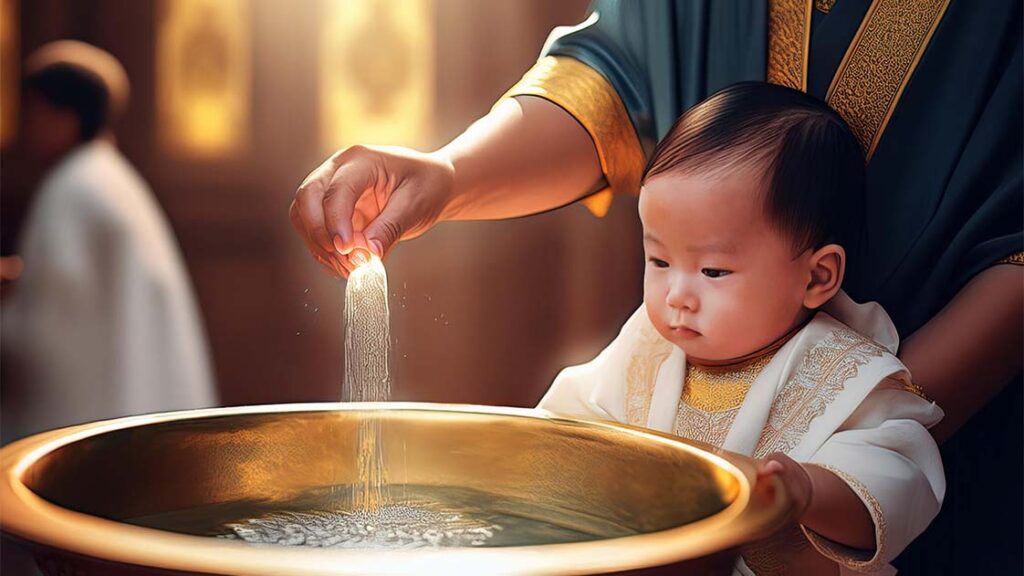
First, we will consider the sacraments of Christianity as they are performed in the Catholic Church. The Christian Church aims to welcome and assist the soul as it comes into its new set of bodies. This is achieved through the ceremony of baptism.
Since it is not possible to reach the soul directly, its vehicles are addressed on the physical plane. The goal is to help the soul get its new set of vehicles in order so that it can work through them. The soul carries within it seeds of good qualities as well as seeds of evil qualities. These seeds of evil are often referred to as “original sin,” but this is a mistaken connection with the fabled action of Adam and Eve.
It is crucial for the child that everything possible is done to suppress the germs of evil and encourage those of good. The sacrament of baptism is specially designed for this purpose. The water used is magnetised with the intention of affecting the vibrations upon the higher vehicles so that all the germs of good qualities in the unformed emotional and mental bodies of the child may receive a strong stimulus, while the germs of evil may be isolated and deadened.
The ceremony also has another aspect: consecrating and setting apart the new vehicles for the true expression of the soul within. When properly and intelligently performed, there is no doubt that its effect is powerful and may impact the entire future life of the child.
The baptismal ceremony brings a new force into activity on the side of the soul in order to influence its vehicles in the right direction. The belief is that at baptism, a guardian angel is given to the child. This is based on the fact that a new thought form, or artificial elemental, is built, which is filled by the divine force and also ensouled by a higher kind of nature-spirit known as a sylph. This thought form remains with the child as a factor on the side of good so that it is essentially a guardian angel. Through this process, the sylph becomes individualised and grows from a sylph into a seraph through its association with a thought form permeated by the life and thought of the Head of the Church Himself (Christ).
The sacrament of baptism cannot alter the disposition of the person, but it can make the person’s vehicle a little easier to manage. It does not suddenly make a devil into an angel or a very evil person into a good one, but it certainly gives the person a better chance. This is its intended purpose and the limit of its power.
Additionally, the baptismal ceremony is intended to open up the chakras, or force-centres, and to set them moving much more rapidly. When this has been done, and the “guardian angel” thought form has been built, the triple spiritual force is poured in at the actual baptism itself through the medium of consecrated water.
As the names of the Trinity are invoked, the force unquestionably flows from the Three Persons of the Solar Deity Himself, though it reaches us through the intermediate stages of the Christ, Who is the Head of the Church and the ordained priest. The thought which fills the guardian angel’s thought form is, in fact, the thought of the Christ Himself.
The sacrament of baptism is primarily intended for infants, and its significance in early childhood cannot be completely replaced by being baptised later in life. An adult who undergoes baptism has likely already established their own spiritual path, but there may still be unresolved issues and impurities in their spiritual energy. These unresolved matters can accumulate and interfere with their spiritual well-being. Baptism in infancy helps to prevent these negative effects.
When it comes to older individuals, a different type of spiritual being is associated with their baptism, one that is more experienced and capable of intellectual growth. This being may seem somewhat cynical, with a patient demeanour but low expectations. In contrast, the spiritual being associated with infant baptism is more optimistic, filled with love, hope, and dreams for the future.
Nevertheless, the baptism of adults can still have a positive and beneficial impact. The anointing with sacred chrism serves to cleanse the spiritual gateway that individuals pass through during sleep and helps to fortify them, especially for young unmarried individuals.
During the sacrament of Confirmation, the bishop pronounces a preliminary blessing to strengthen the connection between the individual and their spiritual essence. This is done to prepare the individual to receive a greater outpouring of the Divine.
As the bishop makes the sign of the cross, he imparts the power of the Third Person of the Trinity to the candidate in three stages, corresponding to the candidate’s three spiritual levels. Note that the term Third Person here refers to the Holy Spirit, which in Hylozoic parlance refers to the Matter aspect of the Holy Trinity.
The divine power flows from the bishop’s soul to the candidate’s higher mind, then moves to the Buddhi/Unity (46) and finally reaches the Atma (45). In each case, it is the Third-Person aspect of these spiritual principles that facilitates the process.
Some candidates are more receptive to this process than others. For some, the effect is profound and enduring, while for others, it may be minimal due to their spiritual development being at an early stage.
Once the awakening process has taken place to the extent possible, there is a filling and sealing of Atma, Buddhi, and Manas. The impact on Atma is reflected in the etheric envelope, that of Buddhi is mirrored in the emotional envelope, and the effect on higher manas is manifested in the mental envelope.
The purpose of the Confirmation is to strengthen the connections between the soul and the personality, as well as between the soul and the monad. This results in a wider and more constant flow of energy. Confirmation prepares a young person for life and makes it easier for the soul to influence and work through their bodies.
Moving on to the Minor Orders or the Church, the Cleric focuses on controlling the physical envelope, the Doorkeeper works on purifying and controlling the emotional envelope, the Reader learns to harness the powers of the mind, the Exorcist’s ordination aims at the causal envelope to develop the will and give the soul more control over the lower bodies, and the Acolyte degree helps to enhance intuition and the buddhic (46) faculty.
This key of symbols is a reference to diagrams that will follow and highlight which symbols refer to a particular stage of development.
In the first diagram, we have illustrated the spiritual condition of an intelligent and cultured layman. The true person, the Monad, is shown on its own plane, that of Adi. The Monad expresses or manifests itself in its three aspects on the plane of Atma, which we will term Atma [1], Atma [2], and Atma [3], marked on the diagrams as A1, A2, and A3, respectively. Notice that all these manifestations are dormant.
Of these three aspects, the first (A1) remains on the plane of Atma, and the second descends or moves outwards to the plane of Buddhi (46), where we will call it Buddhi [1], marked as B1. The third descends or moves out through the two planes and shows itself in the higher mental world as Manas, or M. This aspect, as it descends or moves through the plane of Buddhi, we will call it Buddhi [2] or B2.
These three outer or lower manifestations, A1, B1, and M, taken together, constitute the soul or soul in its causal envelope, as indicated in the diagram by the dotted line which encloses them. B1 and M are now slightly awakened, as shown by the key
Thus, in addition to the principles of Atma, Buddhi, and manas expressed in the soul as A1, B1, and M, there is also, still latent and undeveloped, another aspect of Buddhi (B2) and two aspects of Atma (A2 and A3), making three further aspects still to be brought out of latency and developed into activity.
The principles that exist in Christ-Maitreya also exist in the same order in the Perfect Person, but in the Person’s case, they are fully developed and mystically one with the second Person of the Trinity, the Son. Through ordination, some of these principles in the person being ordained are linked with the corresponding principles of Christ, creating a channel through which spiritual strength and wisdom can flow to the fullest extent of the person’s receptivity.
Who in the Church today has the faintest idea of the significance of the ceremony being performed? We can only guess. From an esoteric perspective, something profound is occurring and should mark a major transition in the supplicant’s journey through the 4th Kingdom of Nature. This also begs the question: those who are being ordained, are they really qualified and have they purified their nature to receive such benedictions? Judging by the number of court cases pending against various religious institutions, I suspect not.
In the next presentation, we will look at the significance of the ordination process on the sub-Deacon, Deacon and the principles of the Priest. Think of these ordinations as a template for the initiation process rather than a religious rite.