

In the previous presentation, we looked at the first three steps along the initiatory path, as presented by Blavatsky and the Theosophical Society. Continuing on this theme, the Fourth Initiation is known as that of the Arhat (46), which means the “worthy”, “the capable”, “the venerable”, or “perfect”. In the Hindu tradition, the Arhat is referred to as the Paramahamsa, the one above and beyond the Hamsa. Hamsa refers to the soul or “I am that”. In the Christian system, the Fourth Initiation is indicated by the suffering in the Garden of Gethsemane, the Crucifixion, and the Resurrection of the Christ; that is a busy schedule.
This Initiation differs from the others in that it has the double aspect of suffering and victory. Hence, a series of events has been employed to represent it. The type of suffering that accompanies the Initiation clears off any arrears of karma that may still stand in the Initiate’s way. The patience and joyousness with which the initiate endures them strengthen their character and helps determine the extent of their usefulness in the work which lies before them.
The Initiate must momentarily experience a state called Avichi, meaning “waveless” or without vibration. In this state, the person feels utterly alone in space, cut off from all life, even from the Logos. It is considered one of the most dreadful experiences a human being can have. This experience seems to have two main effects:
- The candidate may develop empathy for those who experience Avichi as a result of their actions; think Black Magician.
2. The candidate may learn to stand apart from everything external and confirm their own absolute certainty that they are one with the Logos, realising that any feeling of loneliness is just an illusion.
Avichi, for the black magician, is akin to nirvana for the White Adept. Both types of individuals, who are opposites of each other, are yogis, and each experiences the consequences of the path they have followed. One achieves the realisation of oneness and complete isolation of Avichi, while the other achieves the realisation of Nirvana or unity consciousness.
For the Arhat, while still in the physical envelope, the consciousness of the buddhic plane is normal. Standing at the level of the Arhat involves the ability to fully utilise the buddhic or Unity vehicle.
When the Arhat ascends to the buddhic plane (46), it doesn’t mean that manas (47) is lost. Manas is elevated to the buddhic plane, where it has always existed but has not been fully activated until now. The Arhat remains triple, but instead of being on three planes, it is now on two, with atma developed on its own plane, buddhi on its own plane, and manas aligned with buddhi, elevated into intuition. The Arhat then discards the causal envelope because it is no longer needed. When the Arhat wants to descend and manifest on the mental plane again, it creates a new causal envelope. Similarly, at a later stage, the buddhi and the glorified intellect will be elevated to the atmic plane, and the triple spirit will be fully activated. Then, the three manifestations will converge into one. This is a power accessible to the Adept (45), who unifies the Monad and the soul, just as the disciple is attempting to unite the soul with the personality.
The process of drawing up the higher manas from the causal envelope to the buddhic plane alongside buddhi is known as the spiritual soul, a concept introduced by H.P. Blavatsky. The spiritual soul is the combination of buddhi and the manasic aspect of the One, which was integrated into buddhi when the causal vehicle was discarded. This state, referred to as that of the Arhat, is also described by Christian mystics as spiritual illumination, or the Christ within man.
H.P. Blavatsky also classified the mind into four divisions:
1. Manas – the illuminated manas, which is essentially buddhi, or the state when manas becomes merged in buddhi and has no separate will of its own.
2. Manas proper, the higher manas, representing abstract thinking.
3. Antahkarana, the link or bridge between the higher manas and kama manas during incarnation.
4. Kama-manas, which, according to this theory, represents the personality.
In reality, the personality or persona is represented by the lower causal body, which encases the mental, emotional, and etheric envelopes that make up the first Self.
When the Arhat leaves the physical envelope during sleep or trance, they immediately enter the indescribable glory of the nirvanic plane (46). Their daily goal is to ascend further and further into the nirvanic plane, surpassing the four lower planes of matter where the human soul operates. The Arhat has access to the four lowest planes of matter and can concentrate their awareness at any specific sub-level they desire, although there will always be an underlying buddhic and nirvanic consciousness. Why use the terms buddhic and nirvanic here, surely they are one and the same thing. The reason is that plane 46 is described as majoring in Love and Wisdom. Love equates to nirvana, union with all, buddhic with wisdom.
Even at the atmic level, there is some sort of sheath for the Spirit. In a way, it appears to be like an atom, yet in another way, it seems to encompass the entire plane. The individual feels as though they are everywhere but can concentrate their consciousness at any point within themself, and wherever the outflow of energy momentarily decreases, that becomes an envelope for them.
The Arhat must focus on shedding the remaining five of the ten major fetters, which are:—
[6] – desire for beauty of form, or for physical existence in a form, even including that in the heaven world (47).
[7] – desire for formless life.
[8] – pride.
[9] – agitation or irritability, the possibility of being disturbed by anything.
[10] – ignorance.
Arthur Powell states that the Arhat Initiation may be thought of as halfway between the First and the Fifth Initiations. This confirms my suspicion that the first three initiations in the Theosophical model equate to the (i3), positioning an arhat, a 46-self between a 47-self and a 45-self.
In the first half of the Path – from the First to the Fourth Initiation – a person works on freeing themselves from personal limitations and the illusion of “self”. In the second half, they focus on releasing themselves from the illusion of “other”. It is commonly believed that, on average, seven lives are spent between the First and Fourth Initiations and another seven between the Fourth and Fifth. Powell states these figures can vary greatly. In most cases, the actual period may not be very long, as lives are usually taken in immediate succession without breaks in the heaven world. Laurency spins this story another way. He says a probationer is taken on as an accepted disciple when the master feels that the candidate is capable of taking the (i3) within seven incarnations. Laurency gives no figure beyond this. We know in the case of Jeshu, he progressed from being a 47-self to a 44-self in very short order, but I would caution against setting this as a standard that the rest of us could follow!
An Arhat, whose soul is functioning perfectly in the causal envelope, does not need to incarnate again in a physical body and go through the tiresome cycle of birth and death, which can be unpleasant from the soul’s point of view. However, the Arhat may descend to the emotional plane. While in the emotional envelope, they can enter the nirvanic consciousness at any time. If they are in the physical envelope, they can only reach that nirvanic consciousness when leaving the envelope during sleep or trance, as explained earlier.
It should be noted that Nirvanic consciousness refers to consciousness anywhere in the solar system. Mental consciousness is restricted to the mental world of our Planetary Logos. This means if you wish to board a rocket for Mars, you had better get fully functional in your buddhic/unity envelope, or you are not going very far. Having said that, if you are focused in your 46 permanent atom, why would you need a rocket anyway?
The Fifth Initiation elevates a person to the status of a Master, an Adept, or a Superhuman. In Buddhist tradition, this individual is known as the Asekha, which means the “not-disciple” because they have completed their learning and have exhausted the potential of the human kingdoms of nature. In Hinduism, they are referred to as the Jivanmukta, a liberated life, a free being, because their will is aligned with the Universal Will. They are constantly in the light of Nirvana, even in their waking consciousness, if they choose to remain on earth in a physical envelope.
Looking at our now infamous diagram, we can see that a 45-self has a split personality, just like we do. Half of it resides on the 2nd Triad and the other half on the 3rd Triad. Again, the monad is in need of assistance to traverse from one triad level to another. This is done through the good services of a Protogonos, who supplies the monad with an envelope to store whatever goodies it has collected between globe pralayas. For us at present, our causal envelopes serve to store our memories and attributes between incarnations. When the arhat transcends the 45th plane and enters the 44th plane, having taken the (i6), it ascends to what the Theosophists call the Monadic, Laurency calls the sub-manifestational, and Lee Bladon calls the Divine Plane. This plane is beyond not only our words but also our thoughts. As you can see from our diagram, I prefer the Bladon nomenclature.
As stated in the Secret Doctrine, the Adept “begins his Samadhi on the Atmic plane,” considering all planes below the atmic as one to him. Samadhi is defined as “to bring together” or “to direct together,” indicating a state where individual consciousness merges with universal consciousness.
A person achieves Adeptship when they raise their ordinary consciousness to the nirvanic level. What exactly do we mean by nirvanic? The term I prefer is Unity consciousness, as this describes what is happening on this plane and higher planes, with regard to consciousness. What sets the initiate apart and makes them an Adept is that they have unified the Monad with the Soul. By becoming one with the Monad, they have already attained the level of the third or lowest manifestation of the Deity or Logos.
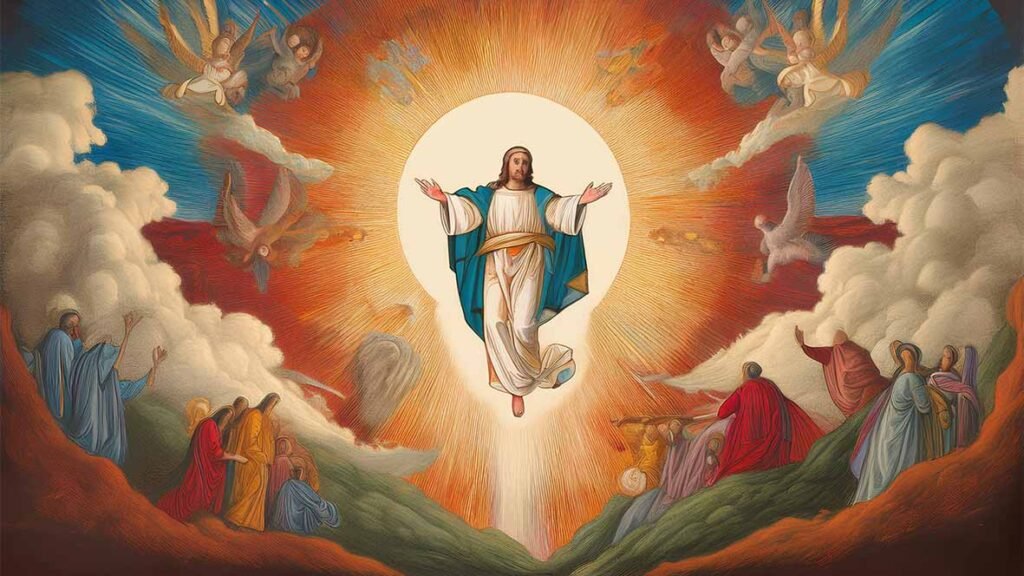
In Christian symbolism, the Ascension and the Descent of the Holy Spirit represent the attainment of Adeptship (45). The Adept ascends above humanity and beyond this earth. However, like Christ, the Adept may choose to return to teach and help. As the Adept ascends, they become one with the Holy Spirit. With this new power, the Adept pours it down upon their disciples, just as Christ poured down tongues of fire upon his followers at the Feast of Pentecost.
During the Asekha Initiation (i5), the atma is perceived as a clear light, a star. As it spreads out, at the final breaking down of the wall, it transforms into the infinite light.
Before that, the Arhat can feel the underlying peace of atma when in a meditative state, but they constantly return to sorrow. However, when a person rises to the atmic plane or lower spiritual plane in full consciousness, and the buddhic consciousness merges into that, only one light is seen. This is expressed in The Voice of The Silence: “The Three that dwell in glory and in ineffable bliss, now in the world of Maya have lost their names. They have become one star, the fire that burns but scorches not, that fire which is the Upadhi of the flame.” Upadhi is used in this context to mean the conditioning of the flame by the fire.
The initiate, while in the causal envelope, witnessed the Sacred Three as separate entities, but now he perceives them as the three aspects of the triple atma. Buddhi and manas, previously described as “twins upon a line” in the buddhic consciousness of the previous stage, are now unified with atma, the fire that serves as the vehicle of the Monadic flame.
The Teacher then inquires: “Where is your individuality, Lanoo? Where is Lanoo himself? It is the spark lost in the fire, the drop within the ocean, the ever-present ray that becomes the All and the eternal Radiance.” The former disciple has now become a Master, standing at the centre with the triple Atma radiating from Him.
The Adept possesses the ability to access any desired knowledge almost instantly. They can merge with it and instantly comprehend its essence, then observe the surrounding details as needed. Somewhere on the buddhic or Nirvanic plane (46), the Asekha would grasp the underlying idea of any specific science or field of knowledge and merge with it. From that perspective, they would then delve into any necessary details.
A Master does not need to have all the knowledge stored within his brain as we do but is able to focus on a particular subject and, through a certain faculty, instantly know all about it. He does not need to study a subject but can gain knowledge by simply focusing on it and absorbing the information.
This may explain how ignorance can be eliminated. With the buddhic faculty, one no longer needs to gather external facts but can delve into the consciousness of anything, whether it be mineral, plant, or Deva, and understand it from within.
In the last of the series of presentations on the second and higher initiations, we will look at some of the activities of the monads that have reached the higher echelons of our solar systemic world.