

In the previous presentation, we looked at the investment the soul made through each incarnation to expand its consciousness. There is one factor that needs to be borne in mind when considering the cycle of life in its entirety. In the cycle of reincarnation, the period spent in devachan or the Mental World is significantly longer than the time spent on earth for all but the most primitive beings. Therefore, it can be considered the normal state. Another reason to view devachan as normal and earthly life as abnormal is that in devachan, a person is much closer to the source of their divine life.
The soul can be seen as an actor, with its many different lifetimes serving as the roles the actor plays. Like an actor, the soul is destined to take on numerous roles, some of which may be challenging. However, like a bee collecting nectar from flowers, the soul gathers only the finest qualities and awareness from each human experience it inhabits. Eventually, it integrates all these qualities into one and evolves into a perfected being, sometimes referred to as a Dhyan Chohan.
In “The Voice of The Silence,” the personalities are called “shadows.” The candidate for initiation is encouraged as follows: “Have perseverance as one who endures constantly. Your shadows come and go, but what lives on in you forever, the knowledge within you, is not fleeting. It is the person who was, is, and will be, for whom the hour will never strike.”
Throughout the ages, the immortal soul patiently works to guide human beings towards unity with the divine. Progress may be slow, with each lifetime contributing only a small improvement, but each incarnation shows some advancement, even if it is initially hard to see. The goal is to diminish the animalistic qualities and enhance the human aspects. As the process unfolds, individuals begin to feel connected to something permanent and immortal, even if they may not fully grasp their ultimate purpose. They start to sense that they are more than just standalone lives and begin to respond to the influence of the soul. From this point, progress accelerates, and development increases significantly in the later stages.
The ideas just spoken are but analogies, perhaps useful but crude. It’s exceedingly difficult to express the soul’s relationship to the personality. Overall, the best way to put it may be to say that the personality is a fragment of the soul, a small part of it expressing itself under serious difficulties. When we meet another person on the physical plane, it would be near the truth to say that we know only a small part of the real person, and often the part we see is the worst part. Even if we are able to look at the causal envelope of another person, we are still far from seeing the true essence of that individual and only see a manifestation of their soul on their plane.
The soul considered the true essence of a person, is a magnificent being when viewed on its own level. It is like a splendid angel, which, at this stage of our evolution, it technically is. However, its expression on the physical plane may not fully portray this magnificence because it is only a small part of the whole, and it is constrained by its surroundings.
If a person puts their finger into a hole in the wall or a small metal pipe so that they cannot even bend the finger, it is obvious that they could express very little through that finger. Similarly, the fate of a piece of the soul placed into this dense envelope is like this.
We can extend the analogy by imagining that the finger possesses its consciousness so that when it is isolated from the rest of the body, it momentarily forgets that it is just a part of the whole body. In this forgetfulness, it tries to conform to the hole, seeking material possessions such as money, property, and fame to make the hole more comfortable and enjoyable. It fails to realise that true fulfilment comes from disengaging from the hole completely and recognising itself as a part of the entire body. Although the analogy may be clumsy, it attempts to illustrate the relationship between the individual personality and the soul.
In certain ancient myths, there are other, more picturesque analogies. For example, Narcissus was a beautiful youth who fell in love with his reflection in the water. He was so infatuated with it that he fell in and drowned. Afterwards, the gods changed him into a flower and bound him to the earth. This myth symbolises the soul looking down upon the emotions and the lower world, seeing itself in the personality, identifying with that personality, falling in love with its image, and becoming attached to earthly desires.
So, similarly, Persephone was seized and carried off by Desire to the underworld while picking the narcissus. Even though her mother made efforts to rescue her from complete captivity, Persephone had to split her life half in the Underworld and half in the above world. This means that she had to spend part of her life in the material incarnation and part of it in her own realm, the home of the gods.
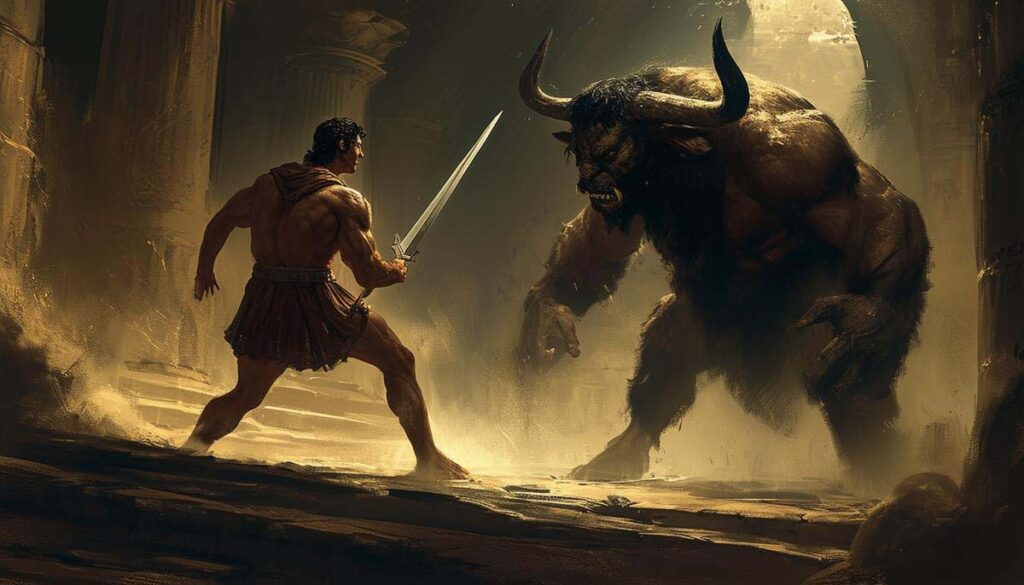
Another mystery teaching revolves around the Minotaur, symbolising the lower nature in human beings – the aspect that is part man and part animal. According to this teaching, Theseus represents the higher self, or individuality, which develops and gains strength over time, ultimately being able to harness the power of its divine origin, the Spirit, to conquer the lower nature.
Guided through the labyrinth of illusion that makes up these lower planes by the thread of occult knowledge given to him by Ariadne (representing intuition), the higher self is empowered to overcome the lower self and safely navigate through the web of illusion. However, there is still the risk that, by developing intellectual pride, he may neglect his intuition.
Understanding reincarnation requires us to consider it from the perspective of the soul. The soul’s movement towards the lower planes forms a vast circular sweep. However, the limited perspective of the individual personality may view only a small portion of this circle as a straight line, placing undue importance on its beginning and end while overlooking the true turning point of the circle.
The soul’s outward force is strong during the early part of life on the physical plane. In ordinary cases, this force becomes exhausted in the middle of life, and the great inward sweep begins.
However, there is no sudden or violent change, as this is not an angle but still part of the curve of the same circle – exactly corresponding to the moment of aphelion in a planet’s course around its orbit. Yet it is the real turning point of that little cycle of evolution, though, with us, it is not marked in any way. In the old Indian scheme of life, it was marked as the end of the grihasta or “householder” period of man’s earthly existence.
In the ancient system, a man spent the first twenty-one years of his life in education and the next twenty-one years fulfilling his duty as a householder and head of the family. However, upon reaching middle age, he would give up his worldly responsibilities, hand over his house and property to his son, and retire with his wife to a small hut nearby. There, he devoted the next twenty-one years to rest, spiritual conversations, and meditation. What was his wife doing with him in the hut? Cooking, of course! Subsequently, he could choose the fourth stage, which involved complete isolation and contemplation in the jungle. This middle stage of life served as the pivotal turning point, underscoring its significant role compared to both physical birth and death, as it marked the limit of the soul’s external energy and transitioned to internal contemplation.
From this point onward, the man should steadily focus his attention more and more on higher planes rather than mundane earthly matters. These considerations highlight how unsuitable modern life is for true spiritual progress.
In the evolution of the soul, the moment when a person passes away is not as crucial as the next change, which is when they transition from the emotional to the mental plane. This transition marks the shift of their consciousness from emotional to mental aspects during the gradual withdrawal process. In Indian philosophy, the descent into matter is called the “pravritti marga,” signifying the pursuit of material existence, while the ascent or return is termed “nivritti marga,” representing renunciation. These terms are relative and can describe the entire journey of the soul’s evolution or an individual’s life in a physical body.
On the path of activity (pravritti marga), which most people follow, desires are necessary and useful as they motivate individuals to take action. However, on the path of renunciation (nivritti marga), desires must cease. What was desire on the path of activity becomes will on the path of renunciation. Similarly, the fluctuating nature of thought becomes reason, and restless action transforms into sacrifice. This transformation breaks the binding force of restless action.
In the following presentation, we will examine how each reincarnation cycle is an investment made by the soul.