

Let’s briefly gather the story so far.
Before the universe is the Ante-verse: infinite, timeless primordial matter, described as both absolutely dense and absolutely elastic. Within it, an Absolute – a fully evolved consciousness – forms a plan and opens a bubble. With that opening, space and time begin.
Now we can step back and ask what happens to the bubble itself.
Our universe is not presented as a permanent fixture. It moves through a cycle: it expands, reaches its fullest development, and eventually withdraws into the Ante-verse from which it came.
The two phases have Sanskrit names. The period of manifestation and expansion is the Manvantara. The period of withdrawal and rest is the Pralaya. Manvantara and Pralaya form the recurring rhythm of a universe.
The words describe more than a beginning followed by a final ending. They suggest a breathing movement: expression and withdrawal, activity and rest. A universe has its season of manifestation, but manifestation is one phase within a much larger continuity.
When a universe withdraws, the Ante-verse is not depleted or damaged by having contained it. It remains as infinite as before, holding the potential for whatever comes next.
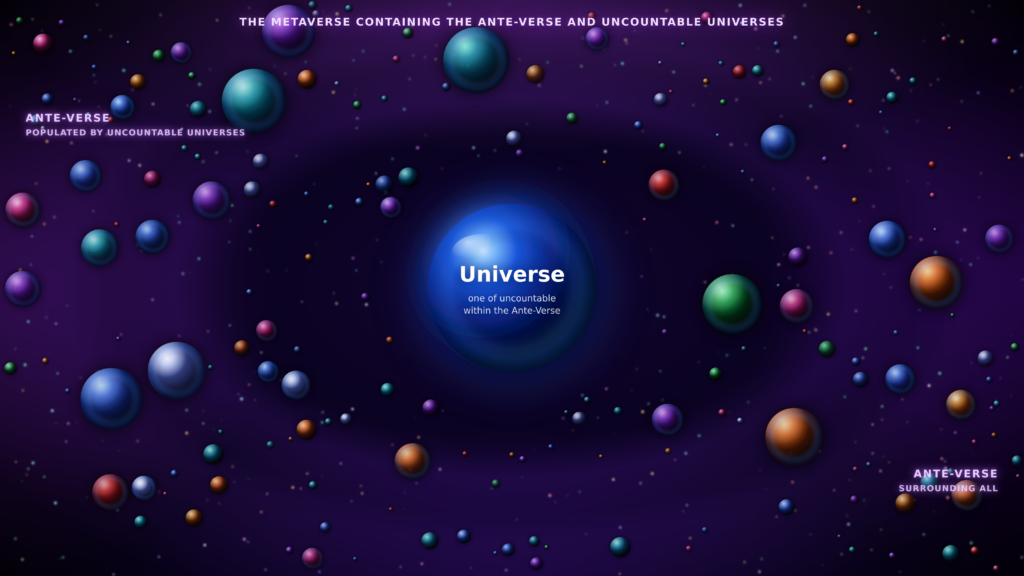
The diagram asks us to consider an even larger possibility: our universe may not be the only bubble open within that ground. Other universes – other Absolutes’ plans and other evolutionary experiments – may exist in parallel with ours.
Those universes need not be copies of this one. Each may express a different plan, while all arise within the same unlimited ground. The idea greatly enlarges the scale of the diagram: what we call the universe becomes one manifestation among possibilities which cannot be counted from within our own bubble.
The Ante-verse also holds Monads from earlier universal cycles: consciousnesses which completed their evolutionary journey in a previous manifestation and now subsist at the highest level between universes.
This gives us an answer to another question. Where do new Absolutes come from?
They arise from that community of evolved Monads. The consciousnesses which complete one great cycle become the potential creators of later cycles. In that way the picture closes upon itself: evolution within a universe eventually produces beings capable of initiating universes of their own.
Every Monad evolving within our universe is travelling that same long road. That includes the Monad in you and the Monad in me. At the end of a completed journey, a Monad is no longer simply developing within a manifestation; it can subsist in the Ante-verse, and some may eventually become Absolutes which form plans and open new bubbles.
The scale is almost impossible to take in, but the principle is simple. The creator of a future universe is not a fundamentally different kind of consciousness. It is consciousness which has completed the development that beings within an earlier universe were beginning.
This is where the cosmology becomes personal.
Our ordinary assumption is that we are very small beings inside an unimaginably large universe: little islands of awareness surrounded by something vastly greater and perhaps indifferent to us.
The teaching turns that picture around through an idea sometimes called the “inverted bubble.” The Monad – our deepest identity – is not simply another object contained inside the universe. The universe is one of the ways through which the Monad appears and develops.
Normally, we treat the container as primary and whatever sits inside it as secondary. Here, the apparent container – the universe, the body, and the personality – belongs to manifestation. The apparently tiny centre of consciousness is closer to the prior ground from which manifestation arises.
This can take time to absorb. The feeling of being small, temporary, and lost in an indifferent cosmos belongs to those parts of us which genuinely operate in space and time: the physical body, the personality, and the changing contents of experience.
The Monad is not lost in quite the same way. It is not merely a passenger trapped inside the bubble. Its nature is more closely related to the ground from which the bubble is formed.
That does not make the body or personality unreal in the everyday sense. They are the instruments through which experience occurs here. The inversion simply asks us not to mistake those temporary instruments for the whole of our identity.
Similar shapes appear in other traditions, even though their language and assumptions differ. Kabbalah speaks of the Ein Soph, the Limitless, and of Tzimtzum: a contraction which makes room for creation. It offers its own image of a space for manifestation opening within an unlimited ground.
In the Christian mystical tradition, Meister Eckhart distinguishes the Godhead from “God” and describes it as “poor, naked, and empty as though it were not.” His language approaches the idea of a reality prior to the forms and distinctions of creation.
These are not identical doctrines, but they echo a recognisable pattern: an unmanifest ground, an opening for manifestation, and a deeper identity which cannot be reduced to the visible world.
The value of these comparisons is not that they prove one another. It is that people working in different traditions and centuries repeatedly reached for similar images when speaking about what lies prior to ordinary existence.
So the three parts of this diagram give us one continuous picture.
Before the universe there was not nothing, but an infinite and timeless density of primordial matter. A fully evolved consciousness opened a bubble within that ground, and space and time began. The bubble is neither permanent nor necessarily alone. Universes move through cycles of manifestation and withdrawal, while evolved Monads become the possible Absolutes of future cycles.
And the Monad in each of us is not simply a small object lost inside that vast process. It is closer in nature to the ground from which the process arises.
That gives us the foundation for the rest of the series. In the next episode, we move from the birth of a universe to its substance and ask: once the bubble exists, what is it actually made of?