

Last time, we explored the idea that before the universe there wasn’t nothing. There was the Ante-verse: primordial matter described as infinitely dense, infinitely elastic, timeless, and changeless.
That left us with a reasonable question. If nothing can move or change, how can a universe ever begin? What turns that timeless ground into a world containing space, movement, and a running clock?
According to this teaching, the answer begins with consciousness.
Within the Ante-verse there are already points of consciousness: fully evolved Monads which have completed entire evolutionary journeys and now exist at the highest level consciousness can reach. One of these is described as an Absolute.
It is worth being precise about that word. Here, “Absolute” does not mean a theological being wholly outside nature, creating by command. It means a supremely evolved Monad. Its basic nature is the same as that of every other Monad, including our own, but its development is incomparably further advanced.
The Absolute begins by forming a plan.
Before the first moment of the universe, that plan already contains its overall arc: the grades of matter that will be required, the kingdoms of nature that will develop, and the evolutionary purpose towards which the whole process will move.
We should not imagine the plan as a schedule of every event that will ever occur. It is closer to an architecture: the conditions, materials, stages, and eventual purpose are present before the building begins. The lives unfolding within that architecture still have their own movement and their own decisions.
We might think of the universe as the material expression of that thought. The thought is so complete, and its unfolding so immense, that it requires an entire bubble of space and time in which to play itself out.
That naturally raises the question of fate. If the plan exists before the universe begins, has everything already been decided?
The teaching makes a distinction between direction and individual experience. The overall destination and broad route are established, but the way each Monad travels is open. The pace, the choices, the resistance, and the willingness to cooperate with development all belong to the individual journey.
So perhaps the picture is less like a train confined to fixed tracks and more like a destination with a general route. We are travelling towards the same broad end, but we do not all travel in the same way or arrive at the same pace.
That distinction allows purpose and freedom to sit together. The universe can have a direction without reducing each Monad to a passive part in a mechanism. Development is offered through the structure, but participation in it remains real.
The Absolute then initiates an expansion within the Ante-verse: a bubble begins to open.
This is the central moment in the episode, because two things appear together which did not exist before. Space is born as the interior of the bubble opens. Time is born as the bubble begins to change and expand.
Before that instant there is no space and no time. After it, there is a universe in motion, with duration of its own.
It is difficult to picture a “before” which contains no time, because the word itself usually means an earlier moment. Here it refers to a different condition altogether. Time does not wait outside the bubble for creation to begin; it belongs to the bubble and begins with its expansion.
This gives us a different way of thinking about a familiar spiritual idea. We often hear that consciousness is trapped in space and time, as though they were prison walls from which we need to escape.
In this model, space and time are not a trap. They are the conditions that make evolution possible. Change requires time, and development requires a field in which it can take place. Without duration, nothing could unfold. Without space, there would be nowhere for differentiated matter and consciousness to develop.
Liberation, then, is not described as fleeing space and time. It is the mastery of the grades of matter within them, from the densest physical matter to the finest causal matter. The purpose is not simply to get out of the universe, but to develop consciously through its whole range.
This changes the emotional tone of the picture. Embodiment is not a cosmic mistake and manifestation is not merely an obstacle. They provide the very field in which dormant capacities can become experience, knowledge, and eventually mastery.
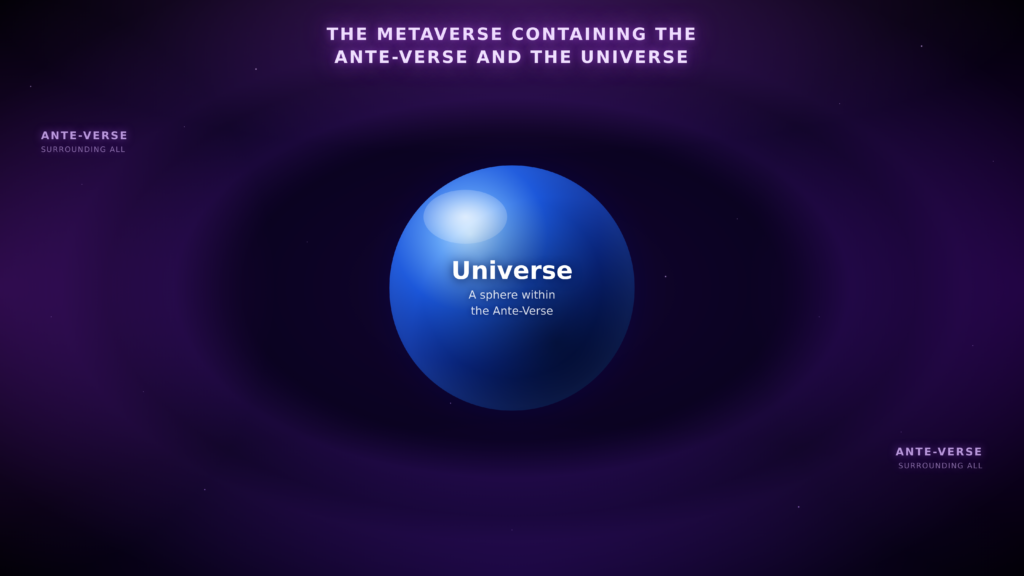
The contrast shown by the diagram now becomes clearer.
Outside the bubble is the Ante-verse: no space, no time, no differentiated matter, and no motion. Fully evolved consciousnesses subsist there between manifestations.
Inside the bubble, space extends, time runs, and matter differentiates into forty-nine grades across seven worlds. Consciousness can develop rather than merely subsist, and motion becomes a basic characteristic of every grade of matter.
It is the difference between an infinite, motionless ocean and a structured, moving bubble arising within it.
But the bubble is not permanent. It expands, reaches its fullest development, and eventually dissolves back into the same Ante-verse from which it emerged. Nor is it necessarily the only bubble present. The infinite ground remains, capable of holding other universes, other plans, and other Absolutes’ evolutionary projects alongside our own.
That is where we will continue in Part 3: what happens when a universe completes its cycle, what other universes may exist within the same ground, and what this enormous picture suggests about the Monad in each of us.