

Last time, I told you what a primary atom is: a piece of the Ante-verse that’s inverted, flipped into its own separate, individual existence — and that same thing, looked at from another angle, is a monad. Yours included. I told you it starts out completely unconscious, and that it wakes up slowly, by circulating through the planes and getting marinated in something called Fohat. What I didn’t tell you is what any of that looks like, up close, at the very place it starts. So — we’re on Plane 1 now. First plane of objective existence. What does that mean for the monad sitting there?
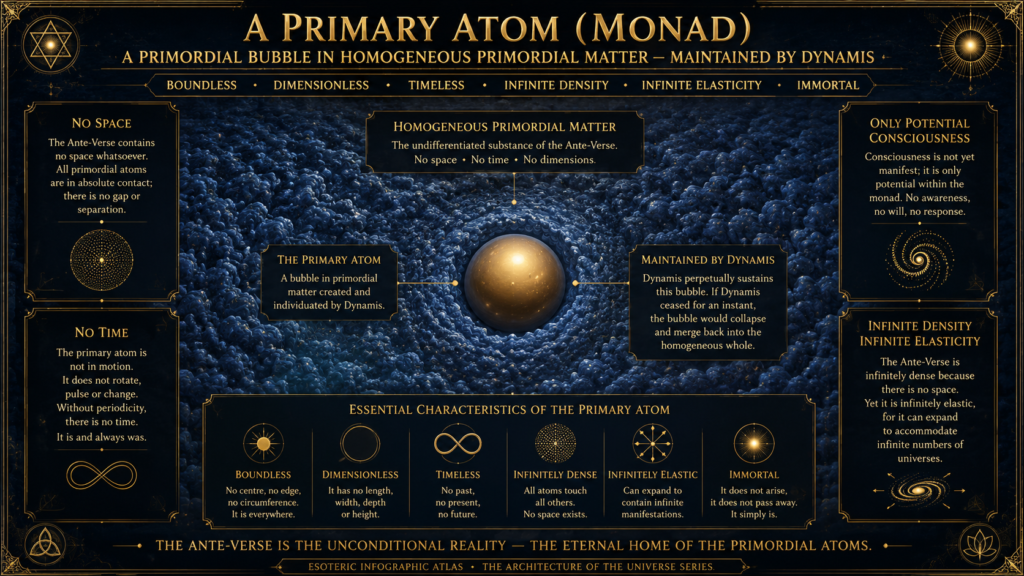
Picture the image for a second: a dark field, scattered with points of light, none of them touching. That’s it. That’s Plane 1. Not a crowd. Not a lattice. Just an enormous number of separate points, each one its own thing, each one sitting in its own little bubble of primordial matter. The diagram calls each of those points a “Primary 1-Atom,” and it gives you, basically, a job description in one sentence: each one is a centre of force within a bubble of primordial matter, maintained by something called Dynamis. It doesn’t touch any other atom. It remains separate and individual. Read that twice, because almost everything else on this diagram is just unpacking those two sentences.
Here’s what I want you to get right before anything else: “separate” and “individual” aren’t loose, poetic words on this diagram. They’re structural. There’s a piece of esoteric lore I’ve worked from before that makes the actual mechanics plain: the only place in the entire system where you get an atom that is the centre of itself — a true single point, with nothing built into it — is right here, on Plane 1. Everywhere else, every plane below this one, what looks like an “atom” is a chain. Forty-nine of these Plane 1 points, strung together, wearing the next plane down like an envelope. Plane 1 doesn’t do that. It’s the one place in the whole architecture that’s irreducible. So when the diagram says “no contact between any primary atoms — no attraction, no repulsion” — that’s not because they happen to be far apart. It’s because contact, at this level, would mean they’re not individual anymore. Separateness here is the definition, not just the current state.
So if nothing’s touching, what’s holding each of these points together as a “thing” at all? The diagram’s answer is one word: Dynamis. And this isn’t the diagram improvising its own vocabulary — it’s using Laurency’s own term, precisely. Dynamis, in this teaching, acts only in primordial atoms. Nowhere else. Every lower, more composite kind of matter has less of this ability, not more. And there’s a line from that same source I think earns a direct quote here, because it’s basically describing this exact diagram: a current of primordial atoms, from the highest cosmic world, is what “makes the universe a perpetuum mobile” — it’s the thing that enables motion to exist, anywhere, at any level. That’s Dynamis. And on this diagram, that same current shows up under a name you might already know — Fohat. Same force. Sustaining each atom from the inside, and driving the one motion every single primary atom does have: it rotates. Constantly. On its own axis. Not moving toward anything, not moving away from anything — just turning, powered from within.
Now here’s the part of the diagram that keeps this from being a story about isolated dots floating in the dark, disconnected from everything else in this series. Plane 1 doesn’t just sit at the top of the stack, minding its own business. It interpenetrates and interweaves every other plane of matter — all forty-eight of the planes below it — conditioning them and vitalising them. Picture the diagram’s own image for this: a single point of light, and its light reaching straight down through a whole stack of lattice structures underneath it. Every grade of matter you’ve heard about in this series so far — Secondary, Tertiary, all the vehicles built out of them — is being quietly soaked, all the way through, by this most subtle plane of all. Nothing further down is cut off from Plane 1. It’s threaded through everything, everywhere, at once — which, if that phrase sounds familiar, is because it’s the same basic move the Ante-verse itself makes, just one level down and one degree more differentiated.
So — back to the actual question. What does all of this mean for the monad?
It means the loneliest-sounding fact in this entire series is also, structurally, a necessary one. Right now, at the level this diagram is showing you, your monad does not touch anything else. No attraction, no repulsion, no contact — full stop. And instead of that being a flaw, or something to eventually escape, it’s the exact condition that makes you irreducibly, unmistakably you. Everything else in this universe that has structure — every chain, every envelope, every body you’ll ever wear — is built by binding many of these separate points together. But the points themselves, at this level, never lose that separateness. It’s the one thing about you that doesn’t get diluted by being combined with anything else.
And there’s a second thing worth carrying with you here, one I flagged back in the Ante-verse episodes and want to bring forward now at a much smaller scale: the diagram calls each primary atom “immortal in essence,” but then adds something specific — it had a birth into the universe, and it will leave it one day. That’s the exact same rhythm as the whole universe’s own Manvantara and Pralaya, the expansion and dissolution I described a few episodes back. Same shape, just run at the scale of a single point of light instead of an entire bubble. You, underneath everything, are running on the same clock the universe itself runs on.
So that’s Plane 1: separate, individual, sustained by Dynamis, threaded through everything below it, immortal in essence. But here’s the question that should already be bothering you, because this diagram basically dares you to ask it — if no primary atom ever touches another one, how does anything ever get built? How do you get from a field of untouching points of light to an actual structured plane, with chains, with envelopes, with bodies? That’s not a small gap to explain away. That’s the next story.