
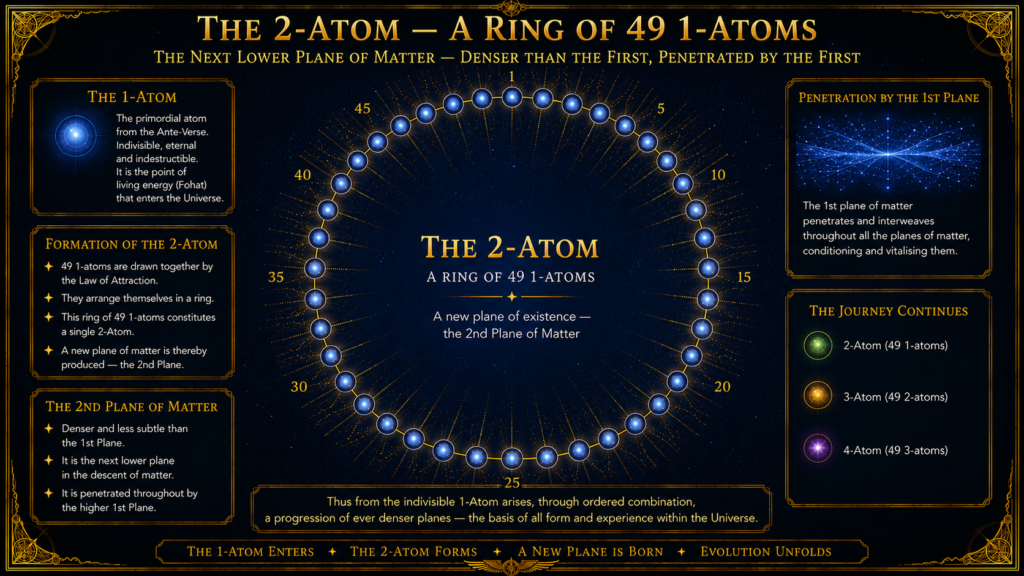

Last time, I left you with a real problem. I told you every primary atom on Plane 1 is separate — no contact, no attraction, no repulsion, completely individual — and then I basically dared you to ask: if that’s true, how does anything ever get built? You can’t build a universe out of points that never touch. So — how does it happen? That’s this diagram.
Quick refresher, because this diagram starts exactly where the last one left off. A 1-atom — the primordial atom straight out of the Ante-verse — is indivisible, eternal, indestructible. It’s a single point of living energy, Fohat, that’s entered the universe and is now sitting there, separate and individual, on Plane 1. That’s the raw material. Now watch what happens to forty-nine of them at once.
Here’s the process, straight off the diagram: forty-nine 1-atoms get drawn together. They arrange themselves into a ring. And that ring of forty-nine — the whole thing, all forty-nine together — constitutes a single 2-Atom. The moment that ring forms, a new plane of matter exists: the 2nd Plane.
Now, the diagram calls this “the Law of Attraction,” and that’s fine as shorthand, but I want to give you the fuller picture, because it’s more interesting than an impersonal force just doing its thing. This isn’t automatic, like gravity pulling rocks together. It’s deliberate. It’s overseen by specific, highly evolved monads called the Logoi — and specifically, the 3rd Logoi, who are literally described as the controllers of matter. When the time comes, they string together forty-nine monads to form a chain. That chain is what becomes the envelope. Nobody’s an accident here. Somebody built it.
And that word “envelope” matters, because I want to gently push back on the diagram’s own name for this thing. It calls it “the 2-Atom.” Fair enough — that’s the working name, and I’ll use it too. But I need to correct something about how I’d naturally describe this, because the obvious way to explain it is wrong.
You’d think: an atom, properly speaking, has a nucleus — some centre, with satellites orbiting it. That’s true. But it’s only true of the atom you learned about in school — a heavy centre, electrons in orbit around it. That’s a Plane 49 idea. That’s how atoms work once you’re all the way down in the molecular, physical world. It has nothing to do with Plane 1.
A monad, by definition, is the smallest possible point of matter there is. It doesn’t have a nucleus, because it doesn’t have parts to begin with. Nothing orbits it, because there’s nothing else inside it or attached to it for anything to orbit. It’s not a miniature version of a schoolroom atom. It’s not a nucleus at all. It’s just a bare point — full stop, nothing to divide, nothing to compound.
So what makes Plane 1 unique isn’t that it has a nucleus. It’s that it’s the one place in the whole architecture where the nucleus-and-satellites picture simply doesn’t apply — an irreducible point, with nothing built into it. And everything from Plane 2 down to Plane 49 is different again, in its own way: not a nucleus with satellites either, but a headless chain — forty-nine peers, bonded together, with no single member controlling the rest and no member you could point to and call the centre. So a 2-Atom isn’t a small version of a schoolroom atom, and it isn’t a bare Plane 1 point either. It functions like an atom, in that it becomes the next plane’s building block. But structurally, it’s an envelope. Forty-nine equals. No nucleus. No satellites. Just a ring.
So what do you get once that ring forms? The 2nd Plane of matter — denser than the 1st, less subtle, one notch further down in the descent of matter. But it’s not cut off from where it came from. Just like Plane 1 penetrates and interweaves through every plane below it, conditioning and vitalising all of them, that penetration is still fully in effect here. The 2nd Plane is denser, yes, but it’s still soaked through with the same Plane 1 energy that built it in the first place.
And here’s the part that should really land: this doesn’t stop at the 2nd Plane. The exact same move happens again, one level up in scale. Take forty-nine 2-Atoms, string them together into a ring, and you get a 3-Atom — the building block of the 3rd Plane. Take forty-nine of those, and you get a 4-Atom, and the 4th Plane. Same mechanism, over and over, recursively, all the way down to Plane 49.
And if you run that math out, the numbers get staggering. By the time you reach Plane 49, the base atomic structure of that plane is built from forty-nine to the forty-eighth power primary monads — that’s something like one point three times ten to the eighty-first. One step back, at Plane 43 — the world our entire solar system sits in — it’s forty-nine to the forty-second, roughly nine point seven times ten to the seventieth. Every single one of those numbers traces back to the same starting move: forty-nine separate, untouching points, strung into a ring by the Logoi.
One more thing worth knowing, even though it’s not the centre of this diagram: every time this ring-building happens, something gets lost as well as gained. A degree of freedom. A dimension. Each plane down loses one relative to the plane above it. That’s a story for its own episode, but it’s worth knowing the two processes — the ring-building you’re looking at right now, and the dimension math — are the same mechanism, described from two different angles.
So here’s the answer to the question I left you with last time. No primary atom ever merges with another one, ever loses its own separateness. What happens instead is that an external agency — the Logoi — strings a set number of them into a shared structure, an envelope, without erasing any single one of them. You can be genuinely, permanently individual, and still be part of something vastly larger than yourself, at the exact same time. That’s not a contradiction. That’s the actual architecture of this universe, from Plane 1 all the way down.
And it’s worth sitting with what this means for you personally, because you’re not looking at this from outside. Every envelope you carry — physical, etheric, emotional, mental, causal, all of it — is, underneath its own particular arrangement, built by exactly this mechanism: primary atoms, strung into rings, strung into bigger rings, over and over. You’re not separate from this process watching it happen. You’re made of it, all the way down.
Forty-nine untouching points. One ring. One new plane. And then the whole thing happens again, and again, all the way to Plane 49. That’s how a universe gets built out of things that never touch each other. What it costs at each step, in dimensions — and what those envelopes look like once you’re wearing one — those are stories for another day.