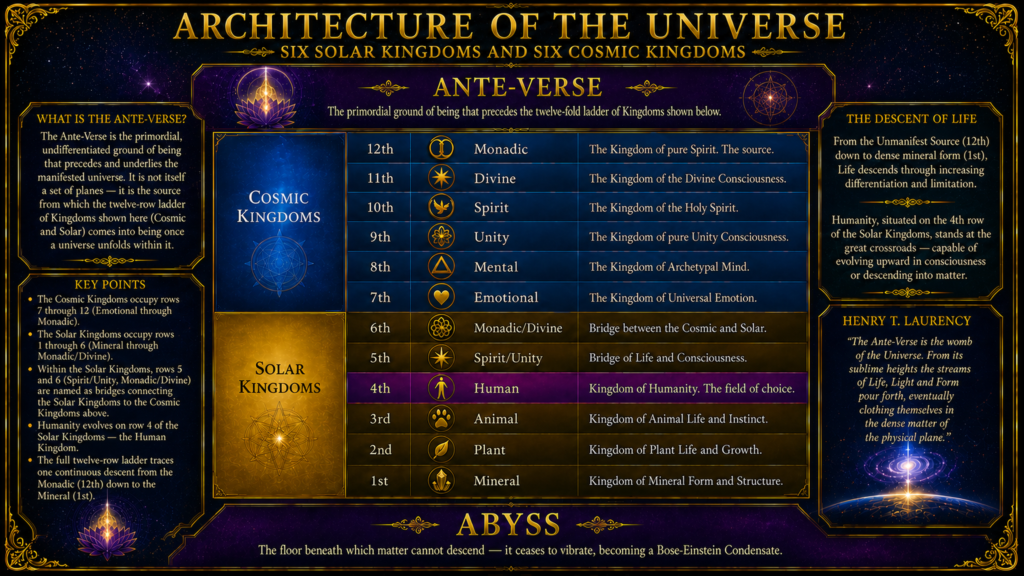

Of everything in the whole Atlas, this is one of the most important diagrams I’ve got. Almost everything we’ve covered so far in this series — the Ante-verse, the primary atom, Plane 1, how one plane builds the next — this diagram takes all of it and lays it out as a single, complete picture. Twelve rows. One descent, from the very top of everything, all the way down to the rock under your feet. Let’s build it.
You already know this part. Before any of the twelve rows on this diagram exist, there’s the Ante-verse — the primordial, undifferentiated ground of being that precedes and underlies the whole manifested universe. It isn’t a set of planes itself. It’s the source the entire twelve-row ladder comes into being from, once a universe unfolds within it. Everything I’m about to describe is downstream of that.
And here’s something new: this diagram also gives you the floor. It’s called the Abyss — the point beneath which matter simply cannot descend any further. And the description it gives is striking: below the Abyss, matter stops vibrating, and becomes what’s called a Bose-Einstein Condensate.
Now, I want to be straight with you about this one, because it’s not something I’ve been able to find sitting in the source texts word for word. A Bose-Einstein Condensate is a real, named thing in modern physics — matter cooled down so far that individual particles stop behaving like separate little billiard balls and start behaving as one single, unified quantum state. I think what’s happening here is that this diagram is borrowing that image, deliberately, as a vivid, modern way of teaching an old idea: that matter has an actual floor, and below it, the normal rules of separate, vibrating, differentiated stuff just stop applying. Treat it as a teaching analogy, not as a claim that physicists have literally discovered the bottom of the cosmic ladder. It’s a useful picture either way.
Okay. Between the Ante-verse at the top and the Abyss at the bottom, twelve rows. And the diagram splits them cleanly in half: six Cosmic Kingdoms, and six Solar Kingdoms.
The Cosmic Kingdoms are rows seven through twelve: Emotional, Mental, Unity, Spirit, Divine, and right at the top, Monadic — described simply as “the source.” The Solar Kingdoms are rows one through six: Mineral, Plant, Animal, Human, and then two more rows right at the top of the Solar half — Spirit slash Unity, and Monadic slash Divine — which the diagram itself labels as bridges. Not full kingdoms in their own right in the same sense as Mineral or Human, but connective tissue, linking the Solar half up into the Cosmic half above it.
And I want you to notice something about those names, because it’s not an accident: the top of the Solar ladder and the bottom of the Cosmic ladder use almost the exact same vocabulary — Spirit, Unity, Divine, Monadic — just applied at two different scales. That’s not sloppy naming. That’s the same underlying structure, repeating itself one octave up. You’ve seen this exact pattern before in this series, when I walked you through how each plane gets built out of forty-nine of the plane below it. This is that same fractal logic, just described now in terms of kingdoms of life rather than atoms and rings.
Here’s an important structural point, and it’s the kind of thing that reframes everything underneath it: those six Solar Kingdoms — Mineral all the way up through the two bridge kingdoms — are, cosmically speaking, one single block. There’s a name for that whole block: the Cosmic Physical. And here’s the part worth sitting with — the Cosmic Physical isn’t itself counted as one of the great cosmic principles. It’s the dense end of the ladder. Everything vast, in the proper cosmic sense, only opens up starting at row seven, the Cosmic Emotional Kingdom, and keeps climbing from there.
So when you’re standing in the Mineral Kingdom, or the Human Kingdom, or anywhere in that first six rows — you’re not standing partway up some enormous structure. You’re still, in cosmic terms, right down at the very base of it. Everything from row seven upward is a whole further order of magnitude beyond what this entire solar system, planes and all, is.
The diagram also carries a quote, attributed to Henry T. Laurency: “The Ante-Verse is the womb of the Universe. From its sublime heights the streams of Life, Light and Form pour forth, eventually clothing themselves in the dense matter of the physical plane.” It’s a beautiful line, and I want to use it — but I also want to be honest with you about where it comes from. I haven’t been able to locate this exact wording anywhere in Laurency’s own texts. My best read is that this is a modern-English rendering of Laurency’s sense, not a literal quotation — the same way the word “Ante-verse” itself is my own teaching term for a concept that’s there in the source material, even though Laurency never used that exact word himself. So take the line as a faithful summary, not a verified direct quote.
And here’s the part of this diagram that’s worth pausing on: right in the middle of the whole twelve-row structure, row four, sits Human. Highlighted, on this diagram, for a reason. The diagram calls it “the field of choice,” and calls humanity, sitting there, “the great crossroads — capable of evolving upward in consciousness or descending into matter.”
Every kingdom below Human — Mineral, Plant, Animal — moves through its stage of the journey automatically, without choosing. Every kingdom above Human, all the way up through the bridges and into the full Cosmic half, has already made its way through that choice point and come out the other side. You are sitting, right now, at the one row on this entire twelve-row ladder where the direction of travel is up to you.
So that’s the shape of the whole thing: Ante-verse above, Abyss below, twelve kingdoms in between, split cleanly into six Solar and six Cosmic, with Humanity sitting at the hinge. Next time, I want to take the Solar half properly — Mineral, Plant, Animal, Human, and the two bridge kingdoms above them — because that’s the story we have the most to say about. After that, we’ll go all the way up into the six Cosmic Kingdoms, where the material gets a lot thinner, and where I’ll tell you exactly how much we do and don’t know.