
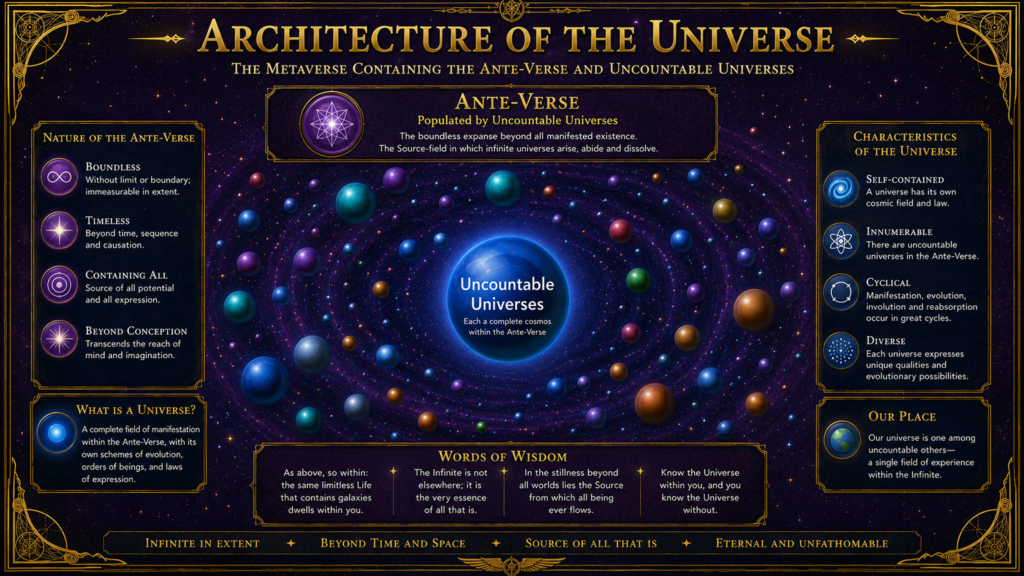

Hello, and welcome to something new on Adventures of the Monad.
I’m calling this series Diagram Deep Dives. Over the years, we’ve used a whole library of diagrams to explore everything from the human aura to the structure of the solar system. Those original diagrams have now been upgraded and brought together in one place: the Knowledge Atlas, which you can browse at AdventuresoftheMonad.com.
What I’d like to do in this series is take those diagrams one at a time and spend a little more time with them. We’ll look at what they contain, where the ideas come from, how different traditions approach them, and—most importantly—why any of it matters.
Some diagrams will fit comfortably into one episode. This first one certainly doesn’t, so we’re beginning with a three-part conversation. And that seems appropriate, because the question behind this diagram may be the largest question we can ask.
The diagram is simply called Metaverse.
Now, I know that word has acquired a rather different meaning in recent years, usually involving technology companies and virtual property. But here I’m using it in its literal sense: meta, beyond—the beyond-verse.
What was there before there was a universe to be inside? Or perhaps a better way of asking it is: what lies beneath everything we call the universe?
The first idea may take a moment to settle, because it runs against the way we normally imagine the beginning. According to this teaching, before the universe there wasn’t nothing. There was what is called the Ante-verse.
The name matters. The Ante-verse isn’t an empty void or the absence of existence. It consists of primordial matter in its most undifferentiated state—before it has been organised into an atom, a planet, a star, or even a thought.
That is quite different from the familiar image of a universe suddenly appearing against a black and empty background. Even a black background would already imply space. The Ante-verse, as it is being described here, comes before there is any space in which a background—or anything else—could exist.
This primordial matter is described as having two qualities which, at first, seem impossible to reconcile.
The first is absolute density.
That doesn’t mean dense in the way we might describe a black hole. It means there is no space between any part of it. To get some sense of the contrast, think about an ordinary physical atom. Almost all of it is empty space. If the empty space were removed from every atom in every living human body, the matter left behind would fit into something about the size of an apple.
It is a startling comparison because the world around us feels solid. The chair beneath us, the ground under our feet, and our own bodies all seem completely substantial. Yet at the atomic level, what we experience as solidity contains an extraordinary amount of space.
The Ante-verse is the opposite of that picture. There are no gaps and no intervals: everything, everywhere, all at once—not merely as a figure of speech, but literally.
And if there is no space, there can be no motion, because motion needs somewhere to happen. Time is our measure of change; without motion there is no change, and without change there is no time.
So the Ante-verse is spaceless, timeless, and changeless.
“Changeless” can sound empty, static, or lifeless, but that isn’t what is meant here. The idea is almost the reverse. The Ante-verse is so completely full that there is nothing outside it and nothing else for it to become. It is a plenitude rather than a vacuum.
That distinction is worth holding onto. We tend to associate stillness with inactivity and emptiness, because that is how stillness appears within our world. Here, stillness is being used to describe completeness: no gap to cross, no external place to reach, and no sequence of events by which one state could turn into another.
That brings us to its second quality—and this is where the picture becomes especially interesting. The same primordial matter that is said to possess absolute density is also said to possess absolute elasticity.
It can accommodate an expanding universe—a whole bubble of space and time opening within it—without being pushed aside, disturbed, or diminished.
At first, that sounds like a contradiction. How can something with no space to spare also have unlimited room for a universe?
The key is that primordial matter isn’t being described as physical matter. Physical things occupy space and displace other physical things. Primordial matter, by contrast, is the ground from which space itself arises.
One way to picture it is to think of a drawing appearing on a blank page. The page doesn’t have to move aside to make room for the drawing. In the same way, the universe doesn’t compete with the Ante-verse for space. Its bubble of space arises within it and from it.
The comparison is only an aid, of course. A physical page already occupies space, whereas the Ante-verse is supposed to precede space. But it helps us loosen the assumption that one thing must always be displaced before another can appear.
This may feel very abstract, but it leads us directly into one of philosophy’s oldest questions: why is there something rather than nothing?
The question often leaves us with two uncomfortable possibilities. Either the universe came from nothing, which is difficult to make logical sense of, or something has always existed, which can feel less like an explanation and more like postponing the question.
The idea of the Ante-verse approaches the problem differently. It isn’t “something” in the ordinary finite and measurable sense. We can’t isolate a piece of it and measure it as we might a planet. But neither is it nothing. It is described as an infinite plenitude of primordial matter, prior to the distinction we normally make between something and nothing.
From this point of view, universes are not conjured out of a void. They arise within a primordial ground that has always been present.
And that gives us the setting—but not yet the beginning of the story.
If the Ante-verse is timeless, motionless, and changeless, what starts a universe? What turns that eternal density into an expanding bubble of space with a clock running inside it?
It isn’t presented as an automatic process. Something—or someone—has to begin it.
That is where we’ll pick up the conversation in Part 2.